Category: Entertainment

  • Phoenix Chi Gulzar : The Complete Guide to the Rising Artist, Creative Journey, Music, and Growing Popularity

    Phoenix Chi Gulzar : The Complete Guide to the Rising Artist, Creative Journey, Music, and Growing Popularity

    The name Phoenix Chi Gulzar has been attracting increasing attention online in 2026, with many people searching to learn more about the artist, creative background, musical style, and growing influence. As digital platforms continue to help emerging talent reach global audiences, Phoenix Chi Gulzar has become a name associated with originality, artistic expression, and creative storytelling.

    Whether you discovered Phoenix Chi Gulzar through music platforms, social media, interviews, or online searches, this complete guide explores everything currently known about the artist, career development, creative identity, and why interest continues to grow.


    Who Is Phoenix Chi Gulzar?

    Phoenix Chi Gulzar is an emerging creative figure whose name has gained visibility through digital media and online communities. The combination of the distinctive names Phoenix, Chi, and Gulzar creates a memorable artistic identity that stands out in today’s competitive entertainment landscape.

    While publicly available information remains relatively limited compared to globally established celebrities, Phoenix Chi Gulzar has attracted curiosity from audiences interested in discovering new artists and independent creators.

    The name itself reflects creativity and individuality, helping establish a recognizable personal brand that resonates with modern audiences.

    As of 2026, Phoenix Chi Gulzar is primarily recognized as a rising artist and creative personality, with growing online interest driven by digital discovery rather than mainstream media exposure.


    The Meaning Behind the Name Phoenix Chi Gulzar

    One reason the name attracts attention is its symbolic significance.

    Phoenix

    The word Phoenix is widely recognized as a symbol of:

    • Rebirth
    • Transformation
    • Strength
    • Resilience
    • Renewal

    Across many cultures, the mythical phoenix represents overcoming challenges and emerging stronger after adversity.

    Chi

    The term Chi traditionally refers to life energy or vital force in several Asian philosophical traditions. It often symbolizes balance, harmony, and inner strength.

    Gulzar

    Gulzar is a name of Persian and South Asian origin commonly associated with meanings such as:

    • Garden
    • Blooming
    • Prosperity
    • Beauty

    Together, these elements create a unique artistic identity that conveys themes of growth, creativity, and personal transformation.


    Creative Style and Artistic Identity

    One of the defining characteristics of Phoenix Chi Gulzar is the emphasis on authentic self-expression.

    Independent artists today frequently build audiences by combining multiple creative disciplines, and Phoenix Chi Gulzar reflects this modern approach.

    Potential areas of artistic expression include:

    • Music
    • Creative writing
    • Visual storytelling
    • Digital media
    • Performance art
    • Social media content

    This multidisciplinary style allows emerging creators to connect with audiences across several platforms while maintaining a distinctive personal identity.

    Rather than relying solely on traditional entertainment channels, many modern artists cultivate communities through direct engagement with fans.


    Why Phoenix Chi Gulzar Is Gaining Attention in 2026

    Interest in Phoenix Chi Gulzar has continued to grow for several reasons.

    Digital Discovery

    Streaming services, video platforms, and social media make it easier than ever for audiences to discover emerging artists from around the world.

    Unique Branding

    The memorable combination of Phoenix, Chi, and Gulzar distinguishes the artist from more conventional stage names.

    Independent Creativity

    Many audiences actively seek creators who produce authentic, original work outside the traditional entertainment industry.

    Global Accessibility

    Digital platforms enable artists to reach international audiences regardless of geographic location, helping new names gain recognition more rapidly than in previous decades.

    These factors have contributed to increasing online searches and growing public curiosity surrounding Phoenix Chi Gulzar.


    The Role of Social Media in Building Recognition

    Modern creative careers are increasingly shaped by online platforms.

    Artists can now share:

    • Original music
    • Behind-the-scenes content
    • Creative projects
    • Personal insights
    • Live performances
    • Collaborative work

    This direct interaction helps build loyal communities while allowing audiences to follow an artist’s creative journey in real time.

    For emerging creators like Phoenix Chi Gulzar, digital engagement often plays a central role in expanding visibility and establishing a recognizable personal brand.


    What Makes Phoenix Chi Gulzar Different?

    The modern entertainment industry values authenticity as much as technical skill.

    Several characteristics contribute to Phoenix Chi Gulzar’s growing appeal:

    Creative Originality

    Distinctive branding and artistic independence help the artist stand out in a crowded digital landscape.

    Symbolic Identity

    The meaningful combination of names conveys themes of resilience, creativity, and transformation.

    Cross-Platform Presence

    Today’s audiences appreciate creators who communicate through multiple forms of media rather than relying on a single format.

    Global Perspective

    Digital audiences increasingly embrace artists whose work resonates across cultures and international communities.

    As more people search for fresh voices and independent talent, artists with unique identities continue to gain recognition.


    Frequently Asked Questions About Phoenix Chi Gulzar

    Who is Phoenix Chi Gulzar?

    Phoenix Chi Gulzar is an emerging creative personality whose growing online presence has attracted attention from audiences interested in music, artistic expression, and independent creators.

    Why is Phoenix Chi Gulzar trending?

    Increasing visibility through digital platforms, unique branding, and audience curiosity have contributed to growing search interest in 2026.

    What does the name Phoenix Chi Gulzar mean?

    The name combines symbolic themes of rebirth (Phoenix), life energy (Chi), and growth or blooming (Gulzar), creating a distinctive artistic identity.

    What type of creative work is associated with Phoenix Chi Gulzar?

    The artist may engage in music, digital media, storytelling, creative content, and other forms of artistic expression, reflecting the multidisciplinary nature of modern creators.

    Why do people search for Phoenix Chi Gulzar?

    Many users are interested in learning about the artist’s background, creative journey, projects, and growing influence across online platforms.


    Conclusion

    In 2026, Phoenix Chi Gulzar represents the growing generation of independent creators who are building recognition through originality, creativity, and digital engagement. Although publicly available information remains limited compared to internationally established celebrities, the artist’s distinctive name and expanding online visibility have sparked increasing curiosity among audiences worldwide.

    The symbolic combination of Phoenix, Chi, and Gulzar reflects themes of renewal, creative energy, and growth, making it a memorable identity in today’s digital entertainment landscape. As online platforms continue to empower emerging talent, Phoenix Chi Gulzar has the opportunity to reach broader audiences and further develop a unique artistic legacy. Whether through music, storytelling, or multimedia projects, the name is one that many people will continue to watch with interest in the years ahead.

  • Mirko: Meaning, Origin, Famous People, Anime Hero, and Why the Name Is Trending in 2026

    Mirko: Meaning, Origin, Famous People, Anime Hero, and Why the Name Is Trending in 2026

    The name Mirko is a powerful, timeless, and internationally recognized name that has gained even greater attention in 2026 through sports, anime, and modern culture. Whether you are researching the meaning of Mirko, learning about the legendary Mirko Cro Cop, or discovering Rabbit Hero Mirko from My Hero Academia, this comprehensive guide explains everything you need to know.

    Rooted in South Slavic history, Mirko has evolved from a traditional European name into a global symbol of peace, strength, courage, and determination. Its growing popularity among parents, sports fans, and anime enthusiasts has made it one of the most searched names in recent years.

    In this guide, we’ll explore Mirko’s meaning, history, popularity, famous personalities, anime connections, and why it remains an excellent baby name choice in 2026.


    What Does Mirko Mean? Origin and Etymology

    The name Mirko has South Slavic origins and is considered one of the most respected traditional masculine names across Europe.

    Linguistically, Mirko is derived from the Old Slavic root “mirŭ”, meaning “peace” or “world.” It is traditionally a diminutive form of Miroslav, a classic Slavic name meaning “peace and glory” or “glorious world.”

    The name combines:

    • Mir – meaning peace or world
    • -ko – a common affectionate suffix used in South Slavic languages

    Together, the name can be interpreted as “the peaceful one” or “one who brings peace.”

    Although its roots are firmly Slavic, Mirko has become widely used in countries including:

    • Croatia
    • Serbia
    • Slovenia
    • Italy
    • Germany
    • Hungary
    • Switzerland

    In Italian traditions, some scholars also associate the name with the Latin word Mirus, meaning “wonderful,” “remarkable,” or “extraordinary.” This combination of peacefulness and excellence gives Mirko a rich and meaningful identity that continues to appeal to families worldwide.


    Mirko Name Popularity and Personality in 2026

    In 2026, Mirko continues to enjoy steady international popularity while remaining uncommon enough to feel distinctive.

    Unlike many trendy names that become overused, Mirko offers the perfect balance between recognition and uniqueness. It has maintained consistent popularity throughout Italy, Croatia, Germany, Hungary, Serbia, and Switzerland, while gradually attracting interest in English-speaking countries.

    Pronunciation

    Mirko is pronounced:

    MEER-ko

    Gender

    The name is traditionally masculine, although it has gained additional recognition because of the female anime hero known as Mirko in My Hero Academia.

    Common Variants

    • Mirco
    • Mirkó
    • Miroslav
    • Miro

    Personality Traits Associated with Mirko

    People often associate the name Mirko with qualities such as:

    • Calmness
    • Bravery
    • Leadership
    • Confidence
    • Kindness
    • Intelligence
    • Resilience
    • Charisma

    Its symbolism combines peace with inner strength, making it an attractive choice for parents seeking a meaningful and internationally respected name.


    Mirko Cro Cop – The Legendary Combat Sports Icon

    When many people search for Mirko, the first person they discover is Mirko Filipović, better known as Mirko Cro Cop.

    Born on September 10, 1974, in Croatia, Mirko Filipović became one of the greatest heavyweight fighters in combat sports history.

    His nickname, “Cro Cop,” stands for “Croatian Cop,” reflecting his service with the Croatian police’s elite Anti-Terrorist Unit ATJ Lučko before achieving international fame.

    Throughout his remarkable career, Mirko competed in some of the world’s biggest organizations, including:

    • UFC
    • PRIDE Fighting Championships
    • K-1
    • RIZIN Fighting Federation
    • Bellator MMA

    His professional MMA record stands at 38 wins, 11 losses, and 2 draws, with 30 victories coming by knockout.

    Mirko became famous for his devastating left high kick, inspiring one of the most memorable quotes in MMA history:

    “Right leg, hospital. Left leg, cemetery.”

    Among his greatest achievements are winning:

    • K-1 World Grand Prix (2012)
    • RIZIN Openweight Grand Prix

    Beyond sports, Mirko also served as a member of the Croatian Parliament from 2003 to 2007, demonstrating leadership outside the fighting arena.

    Even in 2026, Mirko Cro Cop remains one of the most respected and influential figures in martial arts history.


    Rabbit Hero Mirko in My Hero Academia

    For anime fans, Mirko refers to one of the most fearless heroes in My Hero Academia.

    Her real name is Rumi Usagiyama, but she is professionally known as Rabbit Hero: Mirko.

    She quickly became one of the series’ most beloved characters thanks to her fearless personality and incredible combat abilities.

    Character Profile

    • Hero Name: Mirko
    • Real Name: Rumi Usagiyama
    • Birthday: March 1
    • Height: 159 cm
    • Age: 26
    • Quirk: Rabbit

    Her Rabbit Quirk grants her:

    • Extraordinary leg strength
    • Incredible speed
    • Exceptional agility
    • Enhanced jumping ability
    • Outstanding endurance

    Following All Might’s retirement, Mirko became the No. 5 Pro Hero, later ranked No. 6 Pro Hero.

    Unlike many professional heroes, she works independently, operating without an agency or sidekicks. Her determination, muscular athletic design, and fearless attitude have earned worldwide popularity.

    One of her most memorable quotes during the Paranormal Liberation War is:

    “No way this horde of zombies is gonna end Mirko the Hero.”

    With My Hero Academia Season 8, new games such as My Hero Ultra Rumble, and continued fan support, Mirko remains one of the most cosplayed and admired female anime heroes in 2026.


    Other Famous People Named Mirko

    The name Mirko has been carried by many accomplished individuals across sports, media, design, and entertainment.

    Notable examples include:

    • Mirko Cro Cop Filipović – Croatian MMA and K-1 legend
    • Mirko Vučinić – Former Montenegrin football striker who played for Juventus and Roma
    • Mirko Valdifiori – Italian professional footballer
    • Mirko Rosić – Serbian journalist and television presenter
    • Mirko Ilić – Internationally recognized Bosnian graphic designer and illustrator

    These personalities demonstrate how the name Mirko is consistently associated with success, creativity, determination, and excellence.


    Is Mirko a Good Baby Name in 2026?

    Parents looking for a meaningful and memorable baby name increasingly consider Mirko because it combines traditional heritage with modern appeal.

    Why Parents Love Mirko

    1. Powerful Meaning

    Its connection with peace, glory, and strength gives the name lasting significance.

    2. Unique Without Being Unusual

    Mirko remains uncommon in countries like the United States and the United Kingdom while being widely respected throughout Europe.

    3. International Recognition

    The name is easy to pronounce in multiple languages, making it suitable for multicultural families.

    4. Positive Pop Culture Connections

    Mirko represents both a legendary combat sports champion and one of anime’s strongest female heroes.

    5. Simple and Memorable

    With only two syllables, Mirko is easy to spell, pronounce, and remember.

    For parents seeking a name that symbolizes peaceful strength, courage, resilience, and confidence, Mirko is an outstanding choice in 2026.


    Frequently Asked Questions About Mirko

    What does Mirko mean?

    Mirko means “peace” or “world,” and as a diminutive of Miroslav, it also carries the meaning “peaceful glory.”

    Is Mirko a boy’s or girl’s name?

    Traditionally, Mirko is a masculine given name. However, in My Hero Academia, Mirko is the heroic alias of the female character Rumi Usagiyama.

    Is Mirko Cro Cop retired?

    Yes. Mirko Cro Cop has retired from professional MMA competition but continues to be celebrated as one of combat sports’ greatest legends and remains active as a mentor and ambassador for martial arts.

    Why is Mirko from My Hero Academia so popular?

    She is admired for her Rabbit Quirk, unmatched determination, fearless independence, athletic design, and willingness to fight overwhelming odds without hesitation.


    Conclusion

    Mirko is much more than a traditional European name—it represents peace, courage, resilience, glory, and determination. From its South Slavic origins to its worldwide recognition through Mirko Cro Cop and Rabbit Hero Mirko from My Hero Academia, the name has developed a powerful identity that resonates across cultures.

    Whether you are researching the name’s history, searching for inspiration for a baby boy’s name, following combat sports, or enjoying anime, Mirko offers a unique blend of heritage, strength, and modern popularity. As 2026 continues to celebrate influential figures in sports and entertainment, Mirko remains one of the most meaningful, memorable, and globally respected names that will continue inspiring future generations.

  • Soprano Recorder: The Complete Guide to Features, History, Playing Techniques, and Learning Tips

    Soprano Recorder: The Complete Guide to Features, History, Playing Techniques, and Learning Tips

    The soprano recorder is one of the most recognizable and beginner-friendly woodwind instruments in the world. Known for its bright, clear tone and simple fingering system, it has introduced millions of children and adults to the joy of making music. While many people associate the soprano recorder with classroom music lessons, it is also a respected instrument in classical, Renaissance, Baroque, folk, and contemporary music.

    In 2026, the soprano recorder continues to grow in popularity thanks to affordable instruments, online tutorials, music education programs, and professional performers who showcase its impressive musical capabilities. Whether you’re a beginner, parent, teacher, or experienced musician, understanding the soprano recorder can help you appreciate its rich history and versatility.

    This guide covers everything you need to know about the soprano recorder, including its design, history, playing techniques, maintenance, and career opportunities.


    What Is a Soprano Recorder?

    A soprano recorder is a woodwind instrument belonging to the recorder family. Unlike flutes that are played sideways, the recorder is held vertically and produces sound when air is blown through a specially designed mouthpiece called the windway.

    The standard soprano recorder features:

    • Eight finger holes (seven on the front and one thumb hole on the back)
    • A three-piece design on many models for easier tuning and cleaning
    • A bright, high-pitched sound
    • Lightweight and portable construction
    • Easy fingering suitable for beginners

    The soprano recorder is typically tuned in C, making it one of the most commonly used instruments for music education worldwide.


    The History of the Soprano Recorder

    The recorder has a history spanning more than 700 years. Early versions appeared during the Middle Ages, but the instrument flourished during the Renaissance and Baroque periods.

    During the 16th and 17th centuries, composers frequently wrote music for recorder ensembles and solo performances. The instrument became especially popular in royal courts and churches across Europe.

    Famous composers who wrote for the recorder include:

    • Antonio Vivaldi
    • George Frideric Handel
    • Johann Sebastian Bach
    • Georg Philipp Telemann

    Although the recorder declined in popularity during the Classical and Romantic eras, it experienced a major revival in the 20th century through music education and historically informed performances.

    Today, the soprano recorder is enjoyed by students, hobbyists, teachers, and professional musicians around the world.


    Key Features of the Soprano Recorder

    The soprano recorder combines simplicity with impressive musical flexibility.

    Easy to Learn

    The recorder’s straightforward fingering system allows beginners to play simple melodies within a short period of practice.

    Portable Design

    Weighing very little, it can easily fit into a backpack or instrument case, making it ideal for schools and travel.

    Affordable Price

    Plastic beginner recorders are inexpensive, while advanced players can choose handcrafted wooden models for richer tone and greater responsiveness.

    Wide Musical Range

    A standard soprano recorder has a practical range of approximately two octaves, allowing performers to play a wide variety of musical styles.

    Clear and Bright Tone

    Its crisp, cheerful sound makes it suitable for solo performances, ensembles, and educational settings.


    How to Play the Soprano Recorder

    Learning proper technique helps players produce a beautiful tone and avoid common mistakes.

    Correct Posture

    Hold the recorder at a comfortable angle with relaxed shoulders and a straight back.

    Breath Control

    Use gentle, steady airflow rather than blowing forcefully. Excessive air pressure can produce an unpleasant, shrill sound.

    Finger Placement

    Completely cover each finger hole to prevent air leaks that cause incorrect notes.

    Tonguing Technique

    Most beginners learn to articulate notes using syllables such as “tu” or “du,” creating clear note separation without interrupting airflow.

    Practice Scales

    Regular practice of major and minor scales improves finger coordination, intonation, and musical confidence.

    Consistent daily practice of 15–30 minutes can lead to noticeable improvement for beginners.


    Choosing the Right Soprano Recorder in 2026

    With many models available, selecting the right recorder depends on your experience and goals.

    Plastic Recorders

    Ideal for:

    • Beginners
    • School music programs
    • Casual practice
    • Budget-conscious learners

    Advantages include durability, affordability, and easy maintenance.

    Wooden Recorders

    Preferred by advanced students and professionals because they offer:

    • Warmer tone
    • Better dynamic control
    • Improved projection
    • Greater expressive possibilities

    Wooden recorders require more careful maintenance, including proper cleaning and humidity control.

    When purchasing a recorder, consider:

    • Build quality
    • Comfortable finger hole placement
    • Accurate tuning
    • Reliable manufacturer
    • Intended skill level

    Maintenance and Care Tips

    Proper maintenance extends the life of your soprano recorder and helps preserve sound quality.

    Important care practices include:

    • Clean the recorder after every use
    • Dry moisture from the windway
    • Store it in a protective case
    • Avoid exposing it to extreme temperatures
    • Wash plastic recorders according to manufacturer instructions
    • Handle wooden recorders with extra care to prevent cracking

    Routine maintenance ensures consistent performance and reduces unnecessary wear.


    Benefits of Learning the Soprano Recorder

    The soprano recorder offers much more than musical enjoyment.

    Learning the instrument helps develop:

    • Reading music
    • Hand-eye coordination
    • Fine motor skills
    • Listening ability
    • Breath control
    • Concentration
    • Memory
    • Confidence in performing

    For children, the recorder serves as an excellent foundation before progressing to instruments such as the flute, clarinet, saxophone, or oboe. Adults also appreciate its accessibility and the opportunity to explore classical and folk music without investing in expensive equipment.

    In addition, many recorder players join school bands, community ensembles, early music groups, and online music communities where they collaborate with musicians worldwide.


    Why the Soprano Recorder Remains Popular in 2026

    Despite being one of the oldest woodwind instruments, the soprano recorder remains highly relevant in 2026. Its affordability, portability, ease of learning, and rich musical heritage continue to make it a favorite among educators, students, and professional performers alike.

    Modern technology has expanded opportunities through virtual lessons, digital sheet music, instructional videos, and online performances, making recorder education more accessible than ever before.

    Whether used in classrooms, concert halls, churches, or home practice sessions, the soprano recorder continues to inspire musicians of all ages. With regular practice, proper technique, and quality instruction, players can enjoy years of rewarding musical growth while exploring one of history’s most enduring and expressive instruments.

  • Violinist: The Complete Guide to the Art, Career, Skills, and Legacy of Violin Players

    Violinist: The Complete Guide to the Art, Career, Skills, and Legacy of Violin Players

    A violinist is a musician who specializes in playing the violin, one of the world’s most expressive and recognizable string instruments. Whether performing classical masterpieces, jazz improvisations, folk melodies, film scores, or modern pop arrangements, violinists bring emotion, technique, and artistry to every performance.

    In 2026, violinists continue to play an important role in orchestras, chamber ensembles, solo performances, recording studios, film production, education, and digital content creation. Thanks to social media, streaming platforms, and online learning, today’s violinists have more opportunities than ever to reach global audiences and build successful careers.

    This comprehensive guide explores everything you need to know about violinists, from their history and skills to career opportunities and how beginners can start learning the instrument.


    Who Is a Violinist?

    A violinist is someone who plays the violin, a four-string bowed instrument that belongs to the string family. Violinists may perform professionally, teach students, compose music, or simply enjoy playing as a hobby.

    Their responsibilities often include:

    • Performing solo concerts
    • Playing in symphony orchestras
    • Participating in chamber music ensembles
    • Recording music for films, television, and video games
    • Teaching private or group violin lessons
    • Practicing daily to improve technique and musical expression

    Some violinists dedicate their careers to classical music, while others specialize in jazz, bluegrass, country, rock, Celtic, traditional folk, or contemporary genres.

    Regardless of style, becoming a successful violinist requires discipline, creativity, and years of dedicated practice.


    The History of the Violinist Profession

    The violin originated in 16th-century Italy and quickly became one of the most important instruments in Western music.

    Throughout history, violinists have shaped musical culture by performing works from legendary composers such as:

    • Antonio Vivaldi
    • Johann Sebastian Bach
    • Wolfgang Amadeus Mozart
    • Ludwig van Beethoven
    • Niccolò Paganini
    • Pyotr Ilyich Tchaikovsky
    • Johannes Brahms

    During the Romantic era, virtuoso violinists amazed audiences with extraordinary technical skill and expressive performances.

    Today, violinists perform not only in prestigious concert halls but also on:

    • YouTube
    • Spotify
    • TikTok
    • Instagram
    • Film soundtracks
    • Live streaming platforms
    • International music festivals

    The profession has evolved from traditional concert stages into a truly global digital career.


    Essential Skills Every Violinist Needs

    Becoming an accomplished violinist involves much more than learning to play notes correctly.

    Important skills include:

    Technical Ability

    A violinist must develop:

    • Accurate intonation
    • Bow control
    • Finger placement
    • Vibrato
    • Shifting positions
    • Double stops
    • Harmonics
    • Fast scales and arpeggios

    Musical Interpretation

    Great violinists communicate emotion through:

    • Dynamics
    • Tempo changes
    • Phrasing
    • Tone color
    • Musical storytelling

    Sight Reading

    Professional violinists often perform unfamiliar music with little preparation, making strong sight-reading skills extremely valuable.

    Performance Confidence

    Whether playing for five people or five thousand, confidence helps musicians perform at their best.

    Consistent Practice

    Most advanced violinists practice 2–6 hours daily, focusing on technique, repertoire, and performance preparation.


    Different Types of Violinists

    Not every violinist follows the same career path. In 2026, musicians work across many different musical styles.

    Classical Violinists

    These performers specialize in orchestral works, concertos, sonatas, and chamber music.

    Solo Violinists

    Soloists perform with orchestras or give independent recitals featuring technically demanding repertoire.

    Studio Violinists

    Studio musicians record music for:

    • Movies
    • Television
    • Commercials
    • Video games
    • Streaming services
    • Albums

    Folk and Traditional Violinists

    Known in some traditions as fiddlers, these musicians perform Irish, Scottish, Appalachian, bluegrass, and regional folk music.

    Jazz Violinists

    Jazz violinists blend improvisation with advanced harmony and rhythm.

    Contemporary Violinists

    Many modern artists combine violin with:

    • Electronic music
    • Pop
    • Rock
    • Hip-hop
    • Ambient music

    Some also create original arrangements that attract millions of online viewers.


    How to Become a Violinist in 2026

    Anyone can begin learning the violin with dedication and the right guidance.

    Choose the Right Instrument

    Beginners should select a violin that fits their age and arm length. Adults generally use a full-size (4/4) violin, while younger students may require smaller sizes.

    Take Lessons

    Learning from an experienced instructor helps build proper posture, bow technique, and musical fundamentals while avoiding bad habits.

    Practice Regularly

    Consistency matters more than marathon sessions. Even 30–60 minutes of focused daily practice can produce steady improvement.

    Study Music Theory

    Understanding rhythm, scales, harmony, and notation makes learning easier and improves overall musicianship.

    Perform Frequently

    Recitals, school concerts, community ensembles, and online performances help build confidence and stage experience.

    Keep Learning

    Many violinists continue studying throughout their careers by attending masterclasses, workshops, festivals, and advanced training programs.


    Career Opportunities for Violinists

    Modern violinists have a wide variety of professional opportunities beyond traditional orchestras.

    Popular career paths include:

    • Symphony orchestra musician
    • Solo concert artist
    • Chamber ensemble performer
    • Music teacher
    • University instructor
    • Film soundtrack performer
    • Session recording musician
    • Cruise ship entertainer
    • Wedding and event performer
    • Church musician
    • Content creator
    • YouTube performer
    • Streaming artist
    • Composer
    • Music producer
    • Online music educator

    Digital platforms have made it possible for talented violinists to earn income through performances, online lessons, memberships, sponsorships, and music sales.


    Why Violinists Continue to Inspire Audiences

    The violin remains one of the most emotionally powerful musical instruments ever created. Skilled violinists can express joy, sorrow, excitement, romance, and hope using only four strings and a bow.

    Beyond entertainment, learning the violin also offers many personal benefits:

    • Improves concentration
    • Strengthens memory
    • Develops discipline
    • Enhances creativity
    • Builds confidence
    • Encourages emotional expression
    • Supports lifelong learning
    • Connects people across cultures

    In schools, orchestras, recording studios, and online communities, violinists continue to inspire millions of listeners worldwide.

    Conclusion

    A violinist is far more than someone who plays an instrument. They are storytellers, performers, educators, and artists who use music to connect with audiences across generations and cultures.

    In 2026, the role of the violinist is more diverse than ever. From prestigious concert halls to social media platforms, from classical orchestras to film studios and contemporary collaborations, violinists continue to shape the global music landscape.

    Whether your goal is to become a professional performer, teach future musicians, or simply enjoy playing for personal fulfillment, learning the violin is a rewarding journey. With consistent practice, quality instruction, and a passion for music, anyone can develop the skills needed to become a confident and expressive violinist.

  • Flixaba : The Complete Guide to the Streaming Platform, Features, Safety, Legal Considerations, and Best Alternatives

    Flixaba : The Complete Guide to the Streaming Platform, Features, Safety, Legal Considerations, and Best Alternatives

    As online entertainment continues to dominate how people watch movies and TV shows, new streaming-related websites and platforms frequently emerge. One name attracting increasing online searches in 2026 is Flixaba. Many users discover the term while looking for the latest films, trending web series, or online streaming options and naturally ask: What is Flixaba? Is it safe? Is it legal?

    Because platforms using names like Flixaba can change over time, it is important to understand both their potential features and the broader issues surrounding online streaming. Choosing secure and legitimate services protects your privacy, supports content creators, and ensures a better viewing experience.

    This comprehensive guide explains Flixaba, its possible purpose, features commonly associated with streaming platforms, safety considerations, legal aspects, and reliable alternatives available in 2026.


    What Is Flixaba?

    Flixaba is a name commonly associated with websites or online platforms focused on movies, television series, web shows, and digital entertainment. Depending on the specific service using the name, the available content and features may vary over time.

    Users often search for Flixaba when looking for:

    • Latest movie releases
    • Popular TV series
    • Web series
    • International films
    • Regional entertainment
    • Trending online content
    • Movie recommendations
    • Streaming information

    Because websites evolve, users should always verify the authenticity and reputation of any platform before creating an account or accessing content.


    Features Commonly Associated with Flixaba

    Streaming platforms typically aim to provide an organized and convenient entertainment experience. Websites associated with Flixaba may include features such as:

    Extensive Content Categories

    Content is often organized into genres, including:

    • Action
    • Comedy
    • Drama
    • Romance
    • Science Fiction
    • Thriller
    • Horror
    • Animation
    • Family Entertainment
    • Documentaries

    This organization helps users quickly find programs that match their interests.

    Search and Discovery

    Many platforms provide search tools that allow users to browse by:

    • Movie title
    • Actor
    • Genre
    • Language
    • Release year
    • Popularity

    Multi-Device Compatibility

    Modern streaming services are typically optimized for:

    • Desktop computers
    • Laptops
    • Smartphones
    • Tablets
    • Smart televisions

    This flexibility allows viewers to watch content wherever they choose.

    Simple User Interface

    Easy navigation, organized menus, and clearly labeled categories improve the overall viewing experience.


    Is Flixaba Safe to Use?

    Safety depends entirely on the specific website operating under the Flixaba name.

    Before visiting any streaming platform, users should evaluate several important security factors.

    Secure Website Connection

    Always verify that the site uses HTTPS encryption, indicating a secure connection.

    Advertisements

    Unofficial streaming websites may display:

    • Pop-up advertisements
    • Redirect pages
    • Misleading download buttons
    • Aggressive promotional content

    Users should avoid clicking unfamiliar advertisements or downloading unknown software.

    Privacy Protection

    Only provide personal information to trusted websites with transparent privacy policies explaining how user data is handled.

    Device Security

    Maintaining updated antivirus software, browsers, and operating systems helps reduce risks from potentially unsafe websites.


    Legal Considerations When Using Streaming Platforms

    One of the most important questions regarding Flixaba concerns copyright compliance.

    Whether a streaming platform operates legally depends on whether it has authorization to distribute copyrighted content. Legitimate streaming services obtain licenses from production companies, studios, and distributors before offering movies or television shows to viewers.

    To enjoy entertainment responsibly, users should:

    • Respect copyright laws
    • Choose licensed streaming platforms whenever possible
    • Verify the legitimacy of websites
    • Avoid downloading copyrighted material from unauthorized sources

    Supporting licensed services helps filmmakers, actors, writers, and production companies continue creating new entertainment.


    Benefits of Licensed Streaming Services

    Authorized streaming platforms offer several advantages over unofficial websites.

    High-Quality Streaming

    Licensed services typically provide:

    • HD video
    • Full HD
    • 4K Ultra HD
    • High-quality audio

    Reliable Performance

    Official providers invest in:

    • Stable servers
    • Faster streaming
    • Regular platform updates
    • Improved user experience

    Enhanced Security

    Trusted streaming companies implement stronger cybersecurity protections and safeguard customer information.

    Legal Entertainment

    Subscribers enjoy movies and television shows without concerns about copyright compliance.

    Customer Support

    Official services provide technical assistance, account management, and dedicated help centers when users encounter issues.


    Popular Legal Alternatives to Flixaba

    If you’re looking for dependable streaming options, numerous licensed platforms offer extensive entertainment libraries.

    Popular examples include:

    • Netflix
    • Disney+
    • Amazon Prime Video
    • Apple TV+
    • Hulu
    • Max
    • Paramount+
    • Peacock
    • Crunchyroll (for anime)
    • YouTube Movies

    These services regularly add new content while maintaining licensing agreements, strong security, and consistent streaming quality.


    Frequently Asked Questions About Flixaba

    What is Flixaba?

    Flixaba generally refers to an online platform or website associated with movies, television series, and streaming-related entertainment. Features vary depending on the website using the name.

    Is Flixaba free?

    Availability and pricing depend on the individual platform. Users should check the website directly for current information.

    Is Flixaba legal?

    Legality depends on whether the platform has obtained proper licensing rights for the content it distributes. Users should always verify that a streaming service is authorized.

    Is Flixaba safe?

    Safety varies by website. Users should prioritize secure connections, avoid suspicious downloads, and protect personal information when using any online streaming service.

    Why is Flixaba becoming popular?

    Growing demand for online movies, television shows, and digital entertainment has increased interest in platforms associated with streaming content.


    Final Thoughts

    In 2026, Flixaba continues to attract attention from users searching for online entertainment and streaming information. However, as with any digital platform, it is essential to evaluate security, legitimacy, and copyright compliance before using the service.

    The safest and most reliable viewing experience comes from choosing licensed streaming platforms that provide high-quality video, secure technology, regular updates, customer support, and authorized access to entertainment content. These services not only protect users but also support the creators, studios, and production teams responsible for the movies and television shows audiences enjoy.

    Whether researching Flixaba, comparing streaming platforms, or exploring new entertainment options, making informed choices about online safety, legal access, and trusted services ensures a better and more secure streaming experience. As digital entertainment continues to evolve, responsible viewing habits remain the key to enjoying content safely while supporting the future of the entertainment industry.

  • The Ultimate Guide to the Parts of a Guitar: Anatomy, Functions, and Maintenance

    The Ultimate Guide to the Parts of a Guitar: Anatomy, Functions, and Maintenance

    Introduction

    For many, the guitar is more than just an instrument; it’s a companion, a tool for expression, and a gateway to the world of music. Whether you’re a complete beginner dreaming of strumming your first chord or a seasoned player looking to upgrade or maintain your gear, understanding the anatomy of your instrument is a foundational step. Knowing the function of each part not only demystifies the guitar but also empowers you to make informed decisions when purchasing, troubleshooting issues, and communicating with other musicians or technicians. This comprehensive guide will explore every major component of both acoustic and electric guitars, breaking down their functions and explaining how they work together to create the music we love. From the tuning pegs on the headstock to the pickups on the body, we will leave no screw unturned in this detailed exploration of the parts of a guitar.

    The Three Main Sections: An Overview

    At its most basic, every guitar is built upon three primary structural sections: the headstock, the neck, and the body. These foundational parts of the guitar are common to almost every model, whether it is a classical acoustic or a solid-body electric.

    • The Headstock (or Head): Located at the very top of the instrument, the headstock’s primary job is to house the tuning mechanisms that adjust the tension of the strings, thereby setting their pitch.

    • The Neck: The long, slender piece of wood that extends from the headstock to the body. The neck supports the fretboard and frets, where the player presses down on the strings to produce different notes.

    • The Body: The largest part of the guitar, the body serves as the anchor for the neck and bridge. On an acoustic guitar, its hollow chamber amplifies the sound of the strings. On an electric guitar, the body houses the electronics—the pickups and controls—that convert string vibrations into an electrical signal.

    The Headstock: The Tuning Command Center

    The headstock is the control center for the pitch of your guitar, playing a crucial role in keeping the instrument in tune.

    • Tuning Pegs (or Tuners, Machine Heads): These are the knobs located on the headstock. Turning each peg tightens or loosens a string, which changes its pitch. For a standard six-string guitar, you will find six tuning pegs, one for each string. The quality of the tuning pegs can significantly affect how well the guitar stays in tune.

    • String Posts: These are the cylindrical posts on the headstock around which the strings are wound. The string passes through a hole in the post and is wrapped around it, with its tension controlled by the tuning peg.

    • Nut: While technically situated at the junction of the headstock and the neck, the nut is a critical part of the tuning assembly. It is a small, grooved piece of bone, plastic, graphite, or metal that guides the strings from the headstock onto the neck. It keeps the strings properly spaced and at the correct height above the fretboard, playing a key role in playability and tuning stability. This is one of the two main points where the vibrating area of a string ends (the other being the bridge).

    The Neck and Fretboard: The Playable Highway

    The neck is where the left hand (for right-handed players) does most of its work, pressing down on the strings to create different notes and chords. Extending from the body to the headstock, the neck’s structure and components are vital for both sound and playability.

    • The Neck and Fretboard (Fingerboard): The neck is the long piece of wood itself, while the fretboard is the flat, plank-like surface on the front of the neck where you place your fingers. The fretboard is often made of different wood types than the neck, such as rosewood, maple, or ebony, each contributing to a slightly different feel and tone.

    • Frets: The thin metal strips embedded along the fretboard. Pressing a string down onto a fret shortens the effective vibrating length of the string, which raises its pitch. Each fret represents a half-step (semitone) in the musical scale. The material and size of the frets—often nickel silver or stainless steel—affect the guitar’s playability and sustain.

    • Fret Markers (Inlays): These are the dots, blocks, or other decorative shapes inlaid on the fretboard and on the side of the neck. They act as visual guides, helping the player quickly locate specific fret positions, typically at the 3rd, 5th, 7th, 9th, and 12th frets.

    • Truss Rod: This is a crucial, often hidden, component: a metal rod that runs inside the neck. Its purpose is to counteract the immense tension of the strings, which can bend or bow the neck over time. Adjusting the truss rod allows you to fine-tune the neck’s curvature (or “relief”) for optimal playability, helping to eliminate fret buzz or action that is too high.

    The Body: The Heart of the Sound

    The body of the guitar is the largest and most visually striking part of the guitar, and it plays a defining role in the instrument’s voice. However, its function differs significantly between acoustic and electric guitars.

    The Acoustic Guitar Body

    In an acoustic guitar, the body is a hollow chamber designed to project and amplify the sound of the strings naturally.

    • Top (Soundboard), Back, and Sides: The top of an acoustic guitar is not just any piece of wood; it is the ‘soundboard’ and is responsible for producing almost all of the guitar’s acoustic qualities.

    • Sound Hole: A round opening in the top of the body, directly under the strings. The sound hole allows the air inside the guitar’s hollow body to vibrate freely, projecting the sound outward. It is a defining feature that distinguishes an acoustic from a solid-body electric guitar.

    • Bridge: A wooden plate firmly attached to the top of the body, near the bottom. The bridge anchors the strings to the body and transmits their vibrations to the soundboard, which is essential for sound amplification.

    • Bridge Pins: Small posts, usually made of plastic or wood, that secure the ends of the strings into the bridge.

    • Saddle: A thin strip of bone or plastic embedded in the bridge. The strings rest on this saddle, which is the final point of contact before the strings are anchored. It transfers string vibrations to the bridge and ultimately to the soundboard.

    • Pickguard: A protective piece of plastic or other material attached to the top of the guitar, just below the sound hole. Its purpose is to protect the guitar’s finish from scratches caused by a strumming pick.

    The Electric Guitar Body

    The electric guitar body can be solid, semi-hollow, or hollow, but its primary function is to house the electronics that pick up and convert string vibrations into an electrical signal.

    • Pickups: The pickups are the “microphones” of the electric guitar. They are magnets with wire coils that sit under the strings on the body. When a string vibrates, it disrupts the magnetic field, creating a small electrical current that is sent to the amplifier.

    • Pickup Selector Switch: This switch allows the player to choose which pickup (or combination of pickups) is active, dramatically shaping the guitar’s tone. For example, the neck pickup provides a warmer, rounder sound, while the bridge pickup offers a sharper, brighter tone.

    • Bridge: The bridge on an electric guitar serves the same purpose as an acoustic’s, anchoring the strings to the body. 

    • Volume and Tone Knobs: Control knobs on the body are used to adjust the guitar’s output volume and to shape its tone by altering the high or low frequencies (bass and treble) before the signal reaches the amplifier.

    • Output Jack: This is the socket where you plug in a standard 1/4-inch instrument cable. The cable carries the electrical signal from the guitar’s pickups to the amplifier or effects pedals.

    • String Trees (or Retainers): Small metal guides located on the headstock of some electric guitars (particularly models where all the tuning pegs are on one side). They help increase the downward pressure of the strings behind the nut, improving tuning stability and sustain.

    • Whammy Bar (or Tremolo Arm): A metal lever attached to the bridge.

    Conclusion

    The guitar is a marvel of engineering and craftsmanship, with every component working in harmony to produce its iconic sound. It is a gateway to becoming a more informed and capable musician. Whether you are troubleshooting a buzzing string, upgrading a pickup, or simply having a conversation with a fellow guitarist, knowing the parts of a guitar and their functions allows you to connect with your instrument on a deeper level. </span>


    Frequently Asked Questions (FAQ)

    Q: What are the three main parts of a guitar?

    &lt;span class=””>A: All guitars are built upon the same three foundational parts: the headstock (at the top of the neck, containing the tuning pegs), the neck (the long section where you press on the strings to create notes), and the body (the largest section which anchors the bridge and on acoustic guitars amplifies the sound, while on electrics it houses the electronics)<span class=””>.</span>

    Q: Do acoustic and electric guitars have the same parts?

    >A: They share many of the same core parts, including the headstock, neck, fretboard, frets, bridge, and nut.  sound hole to amplify sound naturally, while an electric guitar relies on pickups, a pickup selector switch, volume and tone controls, and an output jack to convert string vibrations into an electrical signal for an amplifier.</span>

    Q: What is the purpose of the little dots on the fretboard?

    A: The dots are called fret markers or inlays. They are visual guides to help the player quickly identify where they are on the neck. 

    Q: What is a truss rod and why is it important?

    A: A truss rod is a metal rod hidden inside the guitar’s neck.

    Q: What is the difference between single-coil pickups and humbuckers?

    A: Both are magnetic pickups on electric guitars that convert string vibrations into electrical signals. Single-coil pickups are known for their bright, clear, and twangy tone, but they can produce a 60-cycle hum. Humbuckers use two coils working together to cancel out this hum, resulting in a thicker, warmer, and more powerful sound.

  • The Ultimate Guide to Singing Techniques: Master Your Voice with Proven Methods

    The Ultimate Guide to Singing Techniques: Master Your Voice with Proven Methods

    Introduction

    The human voice is the oldest and most personal musical instrument, yet mastering it often remains an elusive goal for many aspiring singers. Whether you dream of commanding a stage, expressing yourself through song, or simply improving your karaoke skills, understanding and applying proper singing techniques is the foundation upon which all great vocal performances are built.

    Understanding the Core Principles of Vocal Technique

    Before we can begin to refine our sound, it is essential to understand the foundational principles that support all great singing. 

    Breath Management and Diaphragmatic Support

    Perhaps the most fundamental of all singing techniques is proper breath management. The mechanism of singing begins with a steady, controlled stream of air passing over the vocal folds, causing them to vibrate. Many singers make the mistake of taking shallow, chest-based breaths, which leads to tension, a weak tone, and vocal fatigue. Effective breath control is rooted in diaphragmatic breathing, often referred to as “belly breathing,” where the diaphragm, a large muscle located at the base of the lungs, is engaged. The Art of Vocal Resonance and Open Throat

    Once the breath is managed, the next step is to transform that air into a resonant, beautiful sound. This is achieved through resonance, which is the process of amplifying and enriching the sound produced by the vocal folds. Your throat, mouth, and nasal passages act as resonating chambers. To maximize resonance, singers must strive for an “open throat,” a concept described as la gola aperta in classical pedagogy, which allows for a free, unobstructed path for the sound to travel. In addition to creating space, posture is critical. A tall, aligned posture (head, shoulders, and hips in a straight line) allows the ribcage to expand and the diaphragm to function efficiently. This combination of proper breath support and an open, resonant space gives the voice its core, depth, and carrying power.

    Diction, Dynamics, and Expressive Phrasing

    With a solid technical foundation in place, the focus shifts from simply singing “correctly” to singing expressively. This is where singing transcends mere vocalization and becomes a powerful form of communication and storytelling, engaging the listener on an emotional level.

    The Importance of Diction and Vowel Formation

    Clear diction and precise articulation are essential for conveying the story of a song. The way you shape vowels and articulate consonants directly impacts your vocal tone and intonation. According to Richard Miller, the vowel and its formation are central to vocal technique, and a well-formed vowel is the basis of a beautiful, resonant tone. Focusing on the vowels is key, as vowels carry the sound and are the primary means of projecting your voice. While consonants provide clarity, they must be articulated sharply and cleanly without disrupting the sustained airflow.By understanding these relationships, a singer can improve both their diction and their vocal quality simultaneously.

    Dynamic Shading and Phrasing

    crescendo (gradually getting louder) and decrescendo (gradually getting softer), adds musical interest and drama to a performance. A skilled singer can use dynamics to build tension and release, creating a compelling musical arc. This involves planning the high points of a song and using volume changes to emphasize certain words or phrases. A ballad might begin softly and grow in intensity to a powerful climax, only to fade back to a whisper. However, dynamics are only effective if they are executed with proper technique and make musical and lyrical sense. Furthermore, it is crucial to consider how dynamics and phrasing interact.

    Conclusion

    Mastering singing techniques is a journey of discovery and dedicated practice, not a destination. It is an art form that combines physical discipline, musicality, and deep emotional expression. 

    Frequently Asked Questions (FAQ)

    What are the most important singing techniques for a beginner to learn?

    The most crucial starting point for any beginner is learning diaphragmatic breathing and breath support. Without proper breath management, it is nearly impossible to produce a controlled, resonant tone or sing without experiencing vocal fatigue. Once this foundation is set, focusing on achieving good posture and creating an open, relaxed throat are the next key steps. These core techniques provide the stability and freedom needed to develop other vocal skills safely and effectively.

    How can I improve my vocal range?

    Expanding your vocal range is a gradual process that requires consistent, patient practice. different vocal registers (chest voice, head voice, and mixed voice) smoothly. Working with a teacher is highly recommended for safely expanding your range.

    What is the difference between chest voice, head voice, and mixed voice?

    These terms describe different vocal registers, or areas of the voice, characterized by the way the vocal folds are vibrating and where the resonance is felt.

    • Chest voice is your lower, speaking voice register, producing a fuller, heavier sound. You can feel the resonance vibrate in your chest.

    • Head voice is the higher register, feeling lighter and more resonant in your head or nasal cavities. It is often used for higher notes to achieve a brighter, more flute-like tone.

    • Mixed voice is a blend of the two, allowing a singer to transition seamlessly between registers without a noticeable “break” or “flip.” It is the cornerstone of a modern, powerful, and versatile singing technique, often used in pop, rock, and musical theatre.

    How can I develop vibrato in my singing?

    Vibrato is a slight, rapid fluctuation in pitch that adds warmth and expressiveness to the voice. It is often described as the “natural” result of relaxed, well-supported singing rather than something to be forced. Forcing vibrato by wobbling the jaw or throat will create an unhealthy, uncontrolled sound.

    Why is diction so important in singing?

    Without clear diction, the emotional meaning and lyrical content of a piece are lost, reducing the impact of your performance. Proper diction involves precise articulation of consonants and the formation of clear, resonant vowels. 

    How can I prevent vocal strain and injury?

    breath support to control your sound</span> rather than forcing it from your throat. If you experience pain or fatigue, stop and rest your voice. Staying hydrated is also critical, as it keeps the vocal folds lubricated and resilient.

  • The Funniest Names: A Deep Dive into Humorous Monikers That Will Make You Laugh Out Loud

    The Funniest Names: A Deep Dive into Humorous Monikers That Will Make You Laugh Out Loud

    Introduction

    Names are the very first gift we are given, a tag that follows us through life, shaping first impressions and often influencing our destiny. While most names are chosen with care, love, and a desire for a positive future, there exists a special, glorious corner of the naming world that defies all convention: the world of the truly funny names. These are not just names that are slightly unusual; they are names that stop you mid-sentence, induce a double-take, and inevitably spark a laugh. Whether they are brilliantly crafted puns, unfortunate accidents of language, or the result of parents with a wild sense of humor, these monikers provide a rich vein of comedy that never runs dry. From the playground to the boardroom, the simple mention of a name like “Anita Napp” or “Hugh Jass” can instantly diffuse tension and bring a smile to faces.

    The phenomenon of funny names is not merely a modern internet obsession; it is a cultural constant, a source of amusement that permeates various facets of our lives, from the geographic names of towns to the usernames we create for ourselves online. These names often become cultural touchstones, shared and celebrated for their wit and originality. They can be a great icebreaker or a source of enduring humor within a social circle. What makes a name funny is subjective, but often it relies on clever wordplay, unexpected combinations, or the sheer absurdity of the image a name conjures. This article is designed to be your comprehensive guide to the funniest names ever conceived, serving not just as a list, but as a deep exploration of the creativity, humor, and occasional unintentional comedy that goes into naming. We will explore the different categories of funny names, from the world of puns to celebrity baby name choices, and even take a look at some of the funniest place names and business handles that prove this humor is everywhere.

    The Anatomy of a Hilarious Name

    Understanding why we find certain names funny is a fascinating exploration of language and psychology. According to linguistic studies, humor often arises from the violation of expectations, and funny names are a classic example. When we hear a name, our brains quickly pattern-match it to known naming conventions. A funny name disrupts this pattern, often through puns, homophones, or an unexpected juxtaposition of words, which in turn triggers a surprise response and laughter .

    The most effective funny names often fall into specific categories. The first is the Pun Name, which relies on a play on words to create a double meaning. Classics like “Ella Vader” play on the phonetic similarity to a famous villain, Darth Vader, or “Alotta Drama” creates a comedic expectation for a person’s personality. These names are particularly effective because they require a moment of cognitive processing to “get” the joke, making the punchline more satisfying [citation:3, citation:8, citation:10]. Another popular category is the Descriptive or Evocative Name, which paints a ridiculous picture in the listener’s mind. This includes names like “Sir Laughs-a-Lot,” which suggests a jovial and perhaps overly enthusiastic persona, or “General Sparklehoof,” which combines military rank with whimsical cuteness in a way that is bound to get a giggle [citation:7, citation:10].

    Then there is the category of Unfortunate Names, which are perhaps the most fascinating because the humor is often unintentional. These are names that, while given in sincerity, have a meaning or phonetic quality that leads to inevitable mockery. This can be due to a name sounding like an object or medical condition, such as “Listeria” , or forming an embarrassing phrase when combined with a surname, like a famous individual named “Ima Hogg” . In these cases, the humor is often tinged with a sense of secondhand awkwardness, which makes it even more compelling. The fascination with these names is so strong that there is even a digital tool designed to find names similar to a given word or curse word, highlighting the public’s curiosity for names that fall just on the right side of inappropriate .

    The Funniest Names for Girls

    When it comes to finding the funniest names for girls, the options are as diverse as they are hilarious. Many of the best names are built around puns and clever wordplay that transform a common name into a comedic statement. For instance, names like “Barb Dwyer” (a play on “barbed wire”), “Paige Turner” (a perfect moniker for a book lover), and “Teresa Crowd” (sounds like “tear a crowd”) show a sharp wit and a willingness to embrace a lifetime of introductions that will inevitably be met with a grin . Other puns like “Amanda Lynn” (a strum on “a mandolin”) and “Holly Graham” (a twist on “holy grail”) are equally clever, demonstrating that a simple phonetic shift can turn a mundane name into a work of comedy . These names work because they create a vivid and humorous story or image in the mind of the listener, making them memorable long after the introduction is over.

    Beyond the puns, there is a whole world of names that are just plain quirky or weird, often derived from objects, concepts, or even brands. Some of these names, like “Antarctica,” “Gravity,” and “Cookie,” defy traditional naming logic but offer a unique charm and a guarantee that the bearer will stand out from the crowd . A particularly amusing sub-category is names that are based on food or drink, with options like “Tequila,” “Margarita,” and “Champagne” . While often associated with a fun-loving persona, these names can also be a double-edged sword. More ridiculous options like “Fartisha Sparklina” or “Apricot Twinkletoes” lean into the full absurdity, representing the kind of names that are perfect for a side-splitting username or a fictional character, even if they are a bit too outlandish for an everyday person . The sheer variety showcases that humor is in the eye of the beholder, with some preferring a clever pun and others enjoying the pure nonsense of a “Waffleina Syrups.”

    The Funniest Names for Boys

    The world of funny names for boys is equally rich, often leaning into themes of exaggerated machismo, dad-joke-level puns, and sheer ridiculousness. Some of the most popular funny names for men are built around nicknames that create a larger-than-life persona, such as “Beef Supreme,” “The Guacfather,” or “Lord of the Fries” . These names are perfect for group chats, fantasy football leagues, or gaming handles, as they immediately establish a playful and lighthearted tone. The best nicknames often play with the concept of power or skill in a funny way, like “Captain Obvious,” “Keyboard Cowboy,” or “Lag Lord,” which poke fun at everyday situations and character traits, making them relatable and humorous . They are designed to be catchy, easy to remember, and to spark an instant laugh, fulfilling the essential criteria for a successful funny name.

    Another rich vein of humor for male names is the celebrity parody or pun. These names, such as “Keanu Re-Bros,” “Elon Tusk,” “Justin Beaver,” or “Brad Pitstop,” are instantly recognizable and rely on the audience’s knowledge of the celebrity to land the joke . They are a form of cultural commentary that is both witty and accessible. Furthermore, there are the classic “unfortunate” names that are often trotted out for a quick laugh, like “Mike Hawk,” which is a phonetic equivalent of a crude phrase . The creativity displayed in these categories is notable, with many names combining food, pop culture, and everyday activities to generate comedy. For example, in the workplace, names like “Coffee Goblin” or “Zoom Lord” are a humorous nod to the realities of office culture . This wide range of styles, from the cool and funny like “Swagzilla” to the simply unique like “Bananasaurus Rex,” demonstrates how the concept of a funny name can be adapted to any personality or situation .

    When Places Have Puns: Funniest Geographical Names

    The humor of naming is not confined to people; it extends to the very places we live and travel through. Across the globe, there are towns and villages with names that seem designed to be the punchline of a joke. In Nottinghamshire, UK, there is the village of “Bunny,” a name that is completely unrelated to the animal but is sure to conjure images of fluffy rabbits to any visitor . Not far away is “Blidworth Bottoms,” which, while a real hamlet, has a name that sounds like the punchline to a children’s joke, especially with its sub-location of “Bottoms Farm” and the “Fox and Hounds” pub . Then there is “Scrooby,” a village that likely makes every driver think of a certain cartoon Great Dane, “Scooby-Doo,” creating an automatic smile . These names are so perfectly comical that they often become local tourist attractions or talking points, highlighting how a sense of humor can be embedded in a region’s identity.

    This phenomenon is global. In India, railway stations often bear names that range from the amusing to the downright confusing. Imagine telling a friend you are waiting at the station named “Kala Bakra,” which translates to “Black Goat,” or “Kutta,” which simply means “Dog” . The humor is immediately apparent, especially when considering the typical activities associated with a railway journey. There is also the station named “IB,” which stands out not for humor, but for being the shortest station name in the country . Another example is “Singapur Road,” which, despite its name, is in Odisha, India, and has no connection to the country of Singapore, leading to inevitable confusion and a chuckle . These geographical names are a testament to the fact that humor is universal and can be found in the most ordinary of places, from a local train stop to a small village in the English countryside, adding a layer of lightheartedness to the travel experience.

    The Art of the Funny Username

    In the digital age, the quest for a funny name has moved online, where usernames serve as a digital first impression. A humorous username can be a powerful tool for social media, gaming, and online forums, acting as a beacon for like-minded individuals and a testament to your personality . Just like in the real world, the best funny usernames often rely on puns, pop culture references, and a playful self-deprecation. A name like “Noobmaster 69” is a classic for gamers, gently mocking one’s own skill level or lack thereof . Names that combine a mundane object with a grandiose title, such as “Stapler Bandit” or “The Cereal Killer,” are highly effective because they create a funny and memorable character in a few short words . The key to a great funny username is that it should be instantly understandable and evoke a chuckle without needing a lengthy explanation.

    Many of the principles that make a personal name funny apply directly to usernames. Wordplay remains king, with puns and homophones leading to some of the best handles. The use of alliteration and rhyme, such as in “Banana Hammock King,” can also make a username stickier and more amusing . For those seeking inspiration, there are now dedicated tools and generators that can help craft the perfect funny username based on a given interest or style. An online username generator can provide you with dozens of suggestions in styles like “Funny/Silly,” “Cute,” or “Dark,” ensuring you can find a name that perfectly matches your vibe . These tools often utilize a variety of linguistic techniques, from combining words to using leetspeak, to create unique and humorous handles . The importance of a good username is reflected in the fact that there is even a service designed to find a funny name that sounds the most like a real name or even a curse word, demonstrating that the search for digital humor is a serious, if lighthearted, business .

    Celebrity Baby Names: A League of Their Own

    When it comes to embracing truly unusual and funny names, few groups have done it with as much panache as celebrities. For many famous parents, a unique name is not just a label but a statement of individuality and creative expression for their child. Over the years, celebrity baby names have provided a seemingly endless source of amusement for the public. From the very famous, like Gwyneth Paltrow’s daughter “Apple,” to the more obscure, like Frank Zappa’s children “Moon Unit” and “Diva Muffin,” these choices have often been met with a mixture of awe, confusion, and laughter . The sheer audacity of names like “Moxie CrimeFighter” (Penn Jillette’s daughter) or “Pilot Inspektor” (Jason Lee’s son) places them in a category all their own, where the primary criterion for choosing a name seems to be its shock value and memorability . These names often become a significant part of the celebrity’s public persona, adding another layer to their brand.

    The trend of celebrity baby naming often reflects broader cultural shifts, such as a move away from traditional or conventional choices towards more maximalist and unique options. Some celebrities opt for names that are strong and meaningful, like “Exa Dark Sideræl” (Elon Musk and Grimes), while others choose names that evoke a sense of whimsy and nature, like “Petal Blossom Rainbow” (Jamie Oliver) or “Emerson Clover” (Ashley Tisdale) . The discussion around these names often spills over into public debate about the rights and wrongs of unusual naming, with some experts pointing to research on the potential negative impact such names can have on a child’s life . Despite this, the tradition continues, as celebrities leverage their status to give their children names that guarantee they will never be forgotten. This fascination with celebrity baby names highlights a cultural obsession with names and their power, making it a perfect sub-topic for an article about the funniest names in existence.

    Conclusion

    The world of funny names is a testament to the creativity, wit, and occasional absurdity of human nature. From the brilliantly crafted pun like “Amanda Lynn” to the geographically amusing “Blidworth Bottoms,” these names serve as a constant reminder not to take life too seriously. They pop up in our daily lives, in our social circles, and even in the news, providing moments of levity and connection. The humor derived from a name is a complex mix of linguistic surprise, cultural reference, and the simple joy of a good punchline. Whether it is the name of a person, a place, or a digital avatar, a funny name has the power to break the ice, tell a story, and be remembered long after it is spoken. As we’ve seen from celebrity baby names to local village monikers, the desire to bestow a name that makes people smile is a universal one.

    Ultimately, the search for the funniest name is a celebration of individuality and a rebellion against the mundane. It’s about embracing the power of language to entertain and challenge our expectations. While some funny names are intentional works of comedic genius, others are happy accidents that have become legendary. This exploration into the funniest names showcases the sheer variety of human imagination and serves as inspiration for anyone looking to add a little humor to their own life, whether they are naming a child, a pet, their fantasy football team, or just looking for a laugh. The next time you meet someone with an unusual name, take a moment to appreciate the humor or the story behind it, because in a world that can often be too serious, a funny name is a small but wonderful gift.

    FAQ

    What are the best funny names for a girl?

    The best funny girl names often feature clever puns like “Amanda Lynn” (a mandolin), “Ella Vader” (Darth Vader), or “Paige Turner” (a book reference). Other favorites include “Anita Napp,” “Barb Dwyer,” and “Teresa Crowd,” all of which are classic examples of wordplay that turn a name into a ready-made joke . For a more quirky and unique choice, names like “Cookie,” “Gravity,” or even “Apricot Twinkletoes” can be perfect for a username or a character .

    What are the funniest names for a boy?

    Funny names for boys often lean into over-the-top nicknames like “Beef Supreme,” “Captain Obvious,” or “Lord of the Fries” . For a more modern and digital vibe, gaming-inspired names like “Noobmaster 69” or “Lag Lord” are excellent choices . Celebrity parody names like “Keanu Re-Bros” or “Elon Tusk” are also great for a quick laugh . The key to a great funny boy name is that it should be easy to remember and instantly evoke a playful image.

    What are some funny place names in the world?

    The world is full of places with hilariously named towns. In the UK, you can find the village of “Bunny” in Nottinghamshire, or “Scrooby,” which sounds just like Scooby-Doo . There’s also “Blidworth Bottoms,” which is a real hamlet. In India, railway stations like “Kala Bakra” (Black Goat) and “Kutta” (Dog) are sure to bring a smile, as is the station with the shortest name, “IB” . Even the famous Welsh village “Llanfairpwllgwyngyllgogerychwyrndrobwllllantysiliogogogoch,” while more of a tongue-twister, is also a source of amusement.

    How do I come up with a funny username?

    Creating a funny username is an art form. The most effective ones often use puns, rhymes, or combine a mundane word with a grand title (like “Stapler Bandit” or “Couch Commander”) . Consider your interests—if you’re a gamer, “Respawn King” could work, while a food lover might enjoy “Burrito Picasso.” Many online tools and username generators can also provide instant inspiration by applying different styles to a keyword you provide, such as “Funny/Silly” or “Cute” . The best usernames are snappy, descriptive, and make people chuckle.

    Why are some names considered funny?

    Names become funny for several reasons. The most common is wordplay, where a name sounds like a common phrase or a pun, such as “Hugh Jass” or “Anita Napp” . Names can also be funny because they are simply unexpected, like naming a person “Apricot” or “Gravity,” which violates our social norms about what a name should be . Additionally, unfortunate combinations—where a first and last name sound like an embarrassing phrase—are a classic source of humor, as seen with “Ima Hogg” . Ultimately, humor in names is about surprise, cleverness, and our ability to see the lighter side of language.


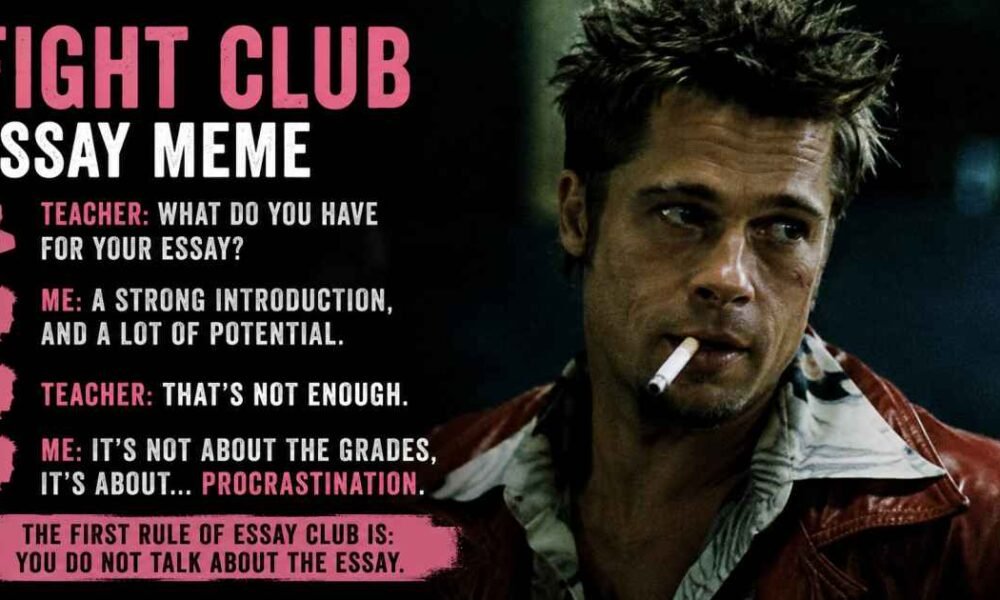
  • The Paradox of the Punchline: Deconstructing the “Fight Club Essay Meme”

    The Paradox of the Punchline: Deconstructing the “Fight Club Essay Meme”

    There is a strange paradox at the heart of modern internet culture, and it is perfectly encapsulated by a single, ubiquitous image macro: a bruised Brad Pitt, a nervous Edward Norton, and the immortal, self-negating commandment: “The first rule of Fight Club is you do not talk about Fight Club.” The “Fight Club essay meme” represents a fascinating cultural phenomenon where the act of sharing a secret becomes the very engine of its propagation.

    The Viral Architecture of the First Rule of Fight Club Meme

    To understand why this image macro and its associated catchphrase represent a failure of cultural literacy, you have to look at the mechanics of how we communicate online today. Most people treat the reference as a simple shorthand for “don’t talk about this,” but that ignores the layered irony of the original text. In the story, the rule was never meant to be followed; it was a psychological trick.

    The digital version of this phenomenon functions as what cultural critics call a “simulacrum”—a copy of a copy where the original meaning has been completely bleached out. We use it to feel like we are part of something exclusive, even though the reference is understood by millions of people across every demographic. There is a particular irony in seeing this used by corporate brand accounts or mid-tier influencers—they are leveraging a story about the destruction of consumerism to boost their engagement metrics.

    The 19-Word Essay: A Viral Meta-Commentary

    Perhaps the purest expression of this cultural drift is the story of Allison Garrett, a student who, in 2019, wrote a 19-word “essay” on Fight Club that went viral and earned her a perfect score. The assignment was to write a movie review. Alli wrote: “The first rule of Fight Club is: you do not talk about Fight Club.” After a series of empty lines that took up the whole page, she concluded with, “That’s it. That’s the essay.” Her professor, displaying a remarkable sense of humor, gave her 100/100, commenting, “I struggled over this grade for a long time. I finally decided you get a grade for a laugh and how relevant your review is for this particular movie”.

    The viral response to this “essay” is a meta-commentary on the meme itself. On one level, the student demonstrated a deep understanding of the film’s most famous rule by refusing to break it. On another level, the internet’s celebration of her “cheat” reinforces the very irony the film critiques—we reward cleverness and surface-level engagement while ignoring the deeper, more uncomfortable questions the movie asks. The professor’s warning, “Do not try this kind of thing with other professors; they may not have my sense of humor,” highlights the reliance on a shared cultural shorthand that has lost its subversive edge.

    Why We Get the Joke Wrong (And Why It Matters)

    Skeptics will argue that it is just a bit of fun, that memes do not need to carry the weight of their source material’s philosophical baggage. They will say that the Fight Club meme is just a useful linguistic tool for acknowledging a taboo without actually breaking it. But that defense falls apart when you look at how the phrase is actually deployed in the wild. It is rarely used to protect something truly subversive. Instead, it is used to gatekeep mainstream hobbies or to add a thin veneer of “cool” to mundane activities. When a group of crypto enthusiasts, gym rats, or marketing professionals use the phrase, they aren’t fighting the system; they are trying to convince themselves that their hobby makes them dangerous or special.

    The power of the original story lay in its raw, uncomfortable look at masculine identity and the vacuum left by a society that prioritizes comfort over purpose. By reducing that complex narrative to a three-second joke, we have sanitized the very thing that made it potent. The meme does not challenge anything; it does not make anyone uncomfortable. It is a security blanket for people who want to feel like rebels without actually taking any risks. As one cultural critic noted, “If you’re using a quote from a movie owned by a multi-billion dollar conglomerate to post on a platform owned by a different multi-billion dollar conglomerate, you aren’t in a fight club. You’re in a focus group”.

    The Commodification of the Underground: From Subversion to Branding

    The most damaging aspect of this cultural drift is how it has trained us to view subversion as a pose rather than an action. In the late nineties, the story felt like a genuine, if violent, critique of how capitalism drains the soul. It was messy, contradictory, and deeply cynical about the possibility of escape. Today, that cynicism has been replaced by a comfortable irony. We don’t want to blow up the system; we just want to post about it in a way that gets us more followers. This shift is visible in how the first rule of Fight Club meme is used in professional settings or high-end marketing. It has been tooth-stripped and declawed until it is as threatening as a “Live, Laugh, Love” sign.

    This is the ultimate irony: the story that warned us against becoming mindless consumers of meaningless products has become a product itself. We have taken a story about the dangers of groupthink and turned it into a tool for groupthink. We are participating in the flattening of our own culture, choosing the easy, recognizable reference over difficult, original thought. As The Atlantic observed on the film’s 25th anniversary, “Fight Club’s insights about the consequences of men rallying around resentment remain apt today,” but the modern manosphere has completely co-opted and misread the film’s satire. The first rule of Fight Club meme has been stripped of its satirical intent and repurposed as a badge of honor for those who see Tyler Durden as a hero rather than a cautionary tale.

    Dismantling the Irony: The Meme as a Mirror

    There will always be those who claim that we are overthinking it, that a meme is just a meme, and that searching for deep philosophical rot in a picture of a sweaty Brad Pitt is an exercise in futility. But images and phrases are the building blocks of our shared reality. How we use them matters. When we take a story about the dangers of groupthink and turn it into a tool for groupthink, we are doing more than just making a harmless joke—we are participating in the flattening of our own culture.

    The survival of this particular cultural reference is not a testament to the movie’s lasting relevance, but rather a testament to our inability to move past it. We are stuck in a loop, repeating the same lines and laughing at the same jokes because we are afraid of what comes next. We are afraid of a world where we cannot define ourselves through the media we consume. So we cling to these old relics, polishing them until they are smooth and useless, pretending that we are still the rebels we once imagined ourselves to be.

    If you really want to honor the spirit of the source material, you shouldn’t post the meme. You should delete the app. You should go outside and do something that cannot be captured in a 1080p rectangle. You should engage in an act that has no potential for “engagement.” The moment you hit “post,” you have already lost the fight. You have submitted to the system that turns every radical thought into a clickable piece of content. You have become a cog in the machine that Tyler Durden wanted to break. The tragedy isn’t that we broke the first rule; it’s that we forgot why the rule was there to begin with. We think we’re the ones in the basement, but we are actually the ones sitting in the theater, watching the movie and waiting for someone to tell us what to think next.

    Conclusion: The Silence We Can’t Keep

    The “Fight Club essay meme” is a perfect representation of our current cultural moment: a paradox where we speak endlessly about our desire for silence, authenticity, and rebellion, but our only language for expressing this is the very medium of noise, performance, and conformity. We have turned the struggle for identity into a template, the rejection of consumerism into a brand, and the silence of the fight club into a roar of digital noise that says absolutely nothing. The joke, it turns out, is on us. We are a generation so steeped in irony that we have forgotten how to be sincere, so addicted to the algorithm that we have lost the ability to keep a secret. In a world that demands we broadcast every thought and feeling for the sake of engagement, true silence is the only rule we seem incapable of following. We are not defying the system; we are the system, desperately trying to convince ourselves that we are the exception. And in that failure to keep quiet, we prove exactly how loud and empty our rebellion has become.

    Frequently Asked Questions (FAQ)

    What is the “Fight Club essay meme”?

    The “Fight Club essay meme” refers to the viral phenomenon where students or internet users reference the film’s famous first rule—”The first rule of Fight Club is you do not talk about Fight Club”—in lieu of writing a substantial essay or commentary. The most famous example is Allison Garrett’s 19-word essay that earned a perfect score, which became a viral sensation on social media.

    Why is the first rule of Fight Club so popular as a meme?

    The rule is popular because it is a paradox: by stating you cannot talk about Fight Club, you are inherently breaking the rule. This self-negating quality makes it perfect for memes, where sharing the “secret” becomes a way to signal belonging to a cultural in-group. However, the joke has largely lost its original subversive meaning, becoming a hollow shorthand for secrecy rather than a critique of groupthink and consumerism.

    Did the student really get an A for a 19-word essay?

    Yes. In 2019, student Alli Garrett wrote a 19-word review of Fight Club for a college assignment. Her essay simply stated the first rule, left a blank space, and concluded with “That’s it. That’s the essay.” Her professor gave her a perfect score, citing the humor and relevance of her response to the movie, while warning other students not to try the same trick with less understanding professors.

    What is the deeper meaning behind the “Fight Club” meme?

    At a deeper level, the meme reflects a failure of cultural literacy. The film was a satire about toxic masculinity, consumerism, and the dangers of groupthink. By reducing it to a catchphrase, we have sanitized its uncomfortable critique and turned rebellion into a pose. The meme is a form of “performative rebellion” that reinforces the very conformity the film mocked—we are consumers of rebellion, not participants in it.

    Why do people misunderstand “Fight Club” so often?

    The film’s aggressive aesthetics and Brad Pitt’s charismatic performance make it easy to idolize Tyler Durden as a hero rather than a villain. This has led to the film being adopted by communities in the manosphere, who see it as a handbook for reclaiming masculinity, despite it being a satire written by a gay author about the destructive nature of such ideologies. The cultural misunderstanding is so prevalent that many universities and critics have noted the film’s legacy is often at odds with its actual message.

    How does the “Fight Club” meme relate to modern internet culture?

    The meme is a quintessential example of how internet culture strips complex ideas of their meaning for easy consumption. It functions as a “digital handshake”—a way to signal media literacy without actual understanding. In the age of algorithms and engagement, the meme persists because it is easy to replicate, offers a sense of identity, and reinforces an “us versus them” dynamic, even though the reference is understood by millions and is far from exclusive.

  • Tempe Tavern: The Complete Guide to Tempe’s Iconic Dive Bar & Music Venue

    Tempe Tavern: The Complete Guide to Tempe’s Iconic Dive Bar & Music Venue

    Introduction

    In the heart of Tempe, Arizona, nestled near the bustling Arizona State University campus, stands a structure that has witnessed nearly a century of change. The building at 1810 East Apache Boulevard is not just another bar; it is a piece of local history, a haven for live music, and one of the most talked-about dive bars in the Valley. This is the home of Tempe Tavern. For those seeking an authentic, unpretentious night out, this spot offers a unique blend of rustic charm, hearty bar food, and a vibrant social scene that has made it a mainstay for generations of locals and students. However, like any establishment with a long and storied past, Tempe Tavern carries with it a reputation marked by both adoration and controversy. Whether you are a first-time visitor looking for a cold beer, a live music enthusiast, or someone curious about the headlines, this comprehensive guide will walk you through the character, history, and current state of this iconic Tempe landmark.

    A Dive into the History and Atmosphere

    To truly appreciate Tempe Tavern, one must first understand its setting. The tavern is located in what is known as the E.M. White Dairy Barn, a structure built around 1918 . This isn’t a modern, prefabricated building; it is a piece of Arizona history, recognized on the National Register of Historic Places . The use of cobblestone, the rustic architecture, and the overall vibe harken back to a time when the area was less about high-rise apartments and light rail stops and more about the agricultural roots of the Valley . The building served as a commercial establishment starting in 1930 and has housed several different taverns over the decades, including Murphy’s Irish Pub, Hattie’s Tavern, and the Oxbow Tavern, before becoming the Tempe Tavern we know today . This deep historical foundation gives the venue an authenticity that is hard to manufacture. Walking through the doors feels like stepping into a different era. The walls, often covered in chalk graffiti and signatures, tell the stories of thousands of patrons who have passed through. It is this nostalgic “dive bar” atmosphere that draws people in, offering a space that feels casual, welcoming, and unlike the polished, sterile environments found elsewhere . The layout is unique, featuring multiple rooms, cozy nooks for conversation, a dance floor, and a stage that has hosted countless local and touring bands .

    The Tempe Tavern Experience: Food and Drinks

    While the atmosphere sets the stage, the food and drink offerings ensure that guests keep coming back. Tempe Tavern prides itself on what it calls “bar food done right” . The menu is a classic collection of American bar fare designed to satisfy cravings and pair perfectly with a cold beer or cocktail. The heart of the menu lies in its appetizers and burgers. Patrons consistently rave about the Tavern Chicken Bites, which are battered chicken breast pieces served with a choice of sauces like medium, hot, or honey BBQ . Another popular starter is the Bottle Caps, which are battered and fried jalapeños served with ranch dressing . For those with a bigger appetite, the burgers are a highlight. The Tavern Burger, a half-pound patty with cheddar cheese and classic toppings, is a staple, but more adventurous eaters might opt for the Juan Pablo, which features pepper jack cheese and a grilled poblano pepper . The menu also includes sandwiches like the Hot Chick (a spicy chicken sandwich) and salads such as the Chopped Chicken Salad for a lighter option . Beyond the food, the drink selection is extensive. The bar features a variety of domestic, import, and craft beers, both in bottles and on tap, showcasing local Arizona breweries . Interestingly, Tempe Tavern holds a unique distinction: it was the only tavern in Tempe to serve wine on tap from Silver Tap Winery . The drink specials are a major draw, with nightly deals that attract a diverse crowd.

    Daily Specials and Events

    Part of what makes Tempe Tavern a local favorite is its aggressive schedule of daily specials and live events. The daily happy hour, running from 4:00 PM to 7:00 PM, offers $3 well drinks and $6 wings, making it a prime spot to unwind after work or before a night out . Each night of the week features its own themed specials, which are heavily advertised to bring in different crowds. On Mondays, the deal is a “Buy One Get One” on all burgers, a favorite for budget-conscious diners, alongside $3 Irish Car Bombs . Tuesdays often feature 2-for-1 well drinks and draft beers . Wednesdays are known as “Get the Red Out,” with specials on red wine and wings . Thursdays might feature white wine and specific liquor specials . The weekends are geared toward larger groups and late-night crowds, featuring specials on nachos, “beermosas” (beer and orange juice), and Bloody Marys . The tavern is not just about food and drink; it is a hub for live entertainment. The stage is a focal point of the venue, hosting live music Wednesday through Sunday . The genres vary, but the venue is known for supporting the local music scene and hosting everything from rock bands to open mic nights . In fact, the open mic nights on Tuesdays have been described by some as “the worlds worst standup comedy,” implying a certain raw, unpolished charm that fits the dive bar aesthetic perfectly .

    The Other Side of the Coin: Controversy and Criticism

    Despite its popularity and historical significance, Tempe Tavern has not been without its significant controversies. In recent years, the bar has been under intense scrutiny from local authorities and law enforcement for alleged systemic violations regarding underage drinking. The Arizona Department of Liquor Licenses and Control (DLLC) conducted a lengthy investigation that resulted in a 257-page report recommending the immediate revocation of the tavern’s liquor license . The report details a series of raids and inspections that resulted in a staggering 422 underage arrests over a two-year period . Investigators described the situation as a “systemic breakdown of operational control” and a “lethal pattern” of underage drinking, citing incidents where minors were allowed to enter with no identification or even paid a fee to bypass security . The statistics are jarring: the Tempe Police Department stated that about 80% of all underage drinking arrests in Tempe during that timeframe took place at Tempe Tavern . The controversy escalated further when a fatal hit-and-run incident occurred involving an ASU student who had allegedly visited the bar before the crash . In response, the owners of Tempe Tavern filed a lawsuit against the city of Tempe, alleging selective enforcement and a “smear campaign” . They argued that on the night of one major raid, the DLLC issued no citations and gave the bar a 100% score on its liquor inspection . This clash between the authorities and the establishment has created a cloud of uncertainty over the venue’s future. It is a stark reminder that the “anything goes” vibe of a dive bar must be balanced with strict adherence to the law.

    The Customer Verdict: A Place of Extremes

    The reviews for Tempe Tavern are as polarized as the headlines. On one side, you have a large group of loyal patrons who swear by the place. Long-time regulars praise the consistency and the atmosphere, often highlighting the exceptional service provided by staff members like bartender Sherry (or Sheri), who is frequently mentioned in reviews for her amazing service and ability to make a mean Dirty Shirley . Many describe the tavern as a “hidden gem,” a “jewel,” and a place where you can have a “great getaway to hang out” . The food, particularly the burgers and chicken bites, receives high marks for being delicious and reasonably priced . For these patrons, the history, the friendly staff, and the unpretentious vibe outweigh any minor shortcomings.

    On the other side, there are deeply critical reviews that paint a very different picture. Many customers complain about poor service, citing rude bartenders, slow drink service, and a general lack of attentiveness . More concerning are the allegations of racism and discrimination, with multiple reviews accusing the bar of unfair treatment towards people of color and inconsistent door policies that seem arbitrary . Some reviewers have claimed that bouncers were unwelcoming or aggressive . There are also frequent mentions of cleanliness issues, from the bathrooms to the general upkeep of the facility . The security and door policy are a frequent point of contention, with complaints ranging from being turned away for having a vertical ID (even if valid) to reports of underage patrons being served, which aligns with the legal issues .

    Is Tempe Tavern Right for You?

    Given the conflicting information and the extreme nature of the reviews, deciding whether to visit Tempe Tavern depends entirely on what you are looking for. If your goal is to experience a piece of Tempe’s history in a laid-back, grungy environment, listen to local live music, and eat some classic bar food with cheap drink specials, then Tempe Tavern might be your perfect spot. The historical backdrop of the old dairy barn, the cobblestone walls, and the dive bar ambiance are undeniably appealing for those who want something authentic and unpretentious.

    However, if you are looking for a polished, high-end experience, if you are sensitive to inconsistent service or a potentially unwelcoming door policy, or if you have concerns about safety and strict adherence to underage drinking laws, you might want to temper your expectations or choose another venue. The controversies are serious and not just background noise; they reflect real operational issues that have led to legal action. It is also worth noting that the future of the bar is uncertain due to the license revocation recommendation, meaning its status could change at any time. For now, Tempe Tavern remains a divided icon. It is a place that inspires immense loyalty and affection in some, and deep frustration and criticism in others. It is, for better or worse, a true dive bar, and with that title comes both the charm of imperfection and the reality of its flaws.

    Conclusion

    Tempe Tavern stands as a monument to the changing face of Tempe itself. Housed in a historic 1918 dairy barn, the tavern offers a nostalgic dive bar experience that feels increasingly rare in a world of slick, modern establishments. Its appeal lies in its authenticity: the cobblestone walls, the eclectic crowd, the live local music, and the dependable “bar food done right” . For many, it is the ideal place to unwind with a cold beer, enjoy a burger, and catch a band. Yet, the tavern is equally defined by its significant controversies, particularly the allegations of rampant underage drinking that have put its liquor license in jeopardy . The deeply polarized reviews—ranging from rave reviews of friendly staff and great food to scathing accusations of racism and poor service—make it a gamble for the uninitiated . Tempe Tavern is, therefore, a place that perfectly encapsulates its dive bar reputation: chaotic, historic, beloved, and flawed. It is an experience that requires the visitor to know what they are getting into. As the legal battles continue and the community watches closely, one thing remains certain: for better or worse, Tempe Tavern remains an indelible part of Tempe’s identity.


    Frequently Asked Questions (FAQ)

    Is Tempe Tavern really in a historical building?

    Yes. The tavern is located in the historic E.M. White Dairy Barn, which was built around 1918 and is listed on the National Register of Historic Places . The building originally served as a dairy facility before becoming a commercial establishment in 1930 .

    What kind of food is served at Tempe Tavern?

    The tavern serves classic American bar fare. The menu includes appetizers like Tavern Chicken Bites and Bottle Caps (fried jalapeños), a variety of half-pound burgers, sandwiches like the Hot Chick, and salads . They are known for having surprisingly good food for a dive bar .

    Does Tempe Tavern have live music?

    Yes, live music is a core part of the Tempe Tavern experience. They host bands Wednesday through Sunday and often feature open mic nights . The stage has been a launching pad for many local and touring acts .

    Are there daily drink specials?

    Yes. The tavern is known for its extensive daily specials, which run from Monday to Sunday. They include deals like “Buy One Get One” on burgers on Mondays and various drink specials throughout the week, including a daily happy hour from 4 PM to 7 PM .

    What are the major controversies surrounding Tempe Tavern?

    The tavern has faced significant legal trouble for systemic underage drinking. A state investigation led to a recommendation to revoke its liquor license following multiple raids that resulted in hundreds of arrests of minors . The owners are fighting the recommendation and have filed a lawsuit against the city of Tempe .