
Tech
Pxless: The Future of Flexible and Pixel-Free Digital Design


What Is Pxless?
The term Pxless, often pronounced as “pixel-less,” refers to a design philosophy that reduces dependency on fixed pixel measurements. It doesn’t mean pixels suddenly disappear from screens. Every digital display still works with pixels at the hardware level. The difference lies in how designers and developers think when building websites and applications. Instead of asking, “Should this box be exactly 400 pixels wide?” a Pxless approach asks, “How should this element behave on different screens and devices?”
This mindset is becoming increasingly important because the internet no longer exists on a single type of screen. Users browse websites from smartphones, tablets, laptops, ultra-wide monitors, smart TVs, and even foldable devices. A layout that looks stunning on one screen can become a complete mess on another. Pxless aims to solve that problem by building systems that adapt naturally. The philosophy places emphasis on relationships, proportions, and flexibility rather than rigid dimensions.
Understanding the Meaning of Pixel-Free Design
Pixel-free design is not about abandoning precision. Surprisingly, it often requires even more planning than traditional methods. Designers need to think about how elements scale, how text behaves, and how content adjusts in different environments. It’s similar to constructing a house that can automatically expand and contract depending on who lives inside it.
The key idea is adaptability. Instead of locking a heading at exactly 36 pixels, designers might use scalable units that respond to screen size or user preferences. This allows websites to remain readable, functional, and visually balanced regardless of the device being used.
Why the Concept Is Gaining Attention
Interest in Pxless has exploded because digital experiences have become incredibly diverse. Millions of users change browser zoom settings, increase text sizes, or access websites using accessibility tools. Traditional pixel-perfect layouts often fail under these circumstances.
Businesses are also discovering that flexible systems require fewer redesigns. Websites built with adaptive principles generally need less maintenance and can handle future devices more easily. In a world where technology changes rapidly, future-proofing has become a major competitive advantage.
The Evolution of Web Design
Years ago, web designers had a relatively simple job. Most users browsed the internet from desktop computers with similar screen resolutions. Fixed-width websites worked perfectly well because everyone saw nearly the same thing.
The digital landscape today looks completely different. Mobile devices dominate web traffic, and users expect seamless experiences across every screen imaginable. This dramatic shift forced designers to rethink their methods and move beyond rigid pixel measurements.
The Era of Pixel-Perfect Design
Pixel-perfect design was once considered the gold standard. Designers obsessed over exact spacing, perfectly aligned elements, and precise measurements. Every pixel mattered.
There was a certain beauty in this approach because it provided total control. A website could be crafted exactly as intended. The problem appeared when the same design had to function on devices with different screen sizes and resolutions. Suddenly, perfection became fragile.
Why Fixed Pixels Started Creating Problems
Imagine buying a suit that fits perfectly today but cannot adjust if your body changes tomorrow. That’s exactly what fixed-pixel design feels like in modern digital environments.
Problems began to appear everywhere:
| Fixed Pixel Problem | Result |
|---|---|
| Small screens | Content becomes cramped |
| Large screens | Layout looks empty |
| Accessibility adjustments | Designs break |
| New device formats | Expensive redesigns |
| High-resolution displays | Inconsistent appearance |
These limitations encouraged designers to seek more flexible solutions, eventually leading to the rise of Pxless methodologies.
Core Principles of Pxless
At its heart, Pxless is built around a few fundamental ideas. These principles help create interfaces that remain stable, accessible, and attractive regardless of where they’re viewed.
Fluid Layouts
Fluid layouts behave almost like water poured into different containers. They adapt naturally to available space instead of fighting against it. Elements grow, shrink, and reposition themselves according to the user’s environment.
This flexibility dramatically improves user experiences. Visitors no longer need to pinch and zoom simply to read content or interact with buttons. The website adjusts itself automatically.
Relative Units
One of the defining features of Pxless is the use of relative measurements instead of absolute ones. Developers increasingly rely on percentages, scalable typography systems, and viewport-based measurements.
Relative sizing creates harmony. Text maintains proper proportions, spacing remains balanced, and layouts feel consistent regardless of screen dimensions. The website becomes a living system rather than a static picture.
Content-First Thinking
Traditional design often forces content into predefined boxes. Pxless flips this idea upside down by allowing content to influence layout decisions.
This approach recognizes an important truth: people visit websites for information, not perfectly measured boxes. When content becomes the priority, interfaces tend to feel more natural and user-friendly.
Benefits of Using Pxless
The benefits of Pxless extend far beyond aesthetics. Companies adopting adaptive design principles often enjoy better performance, improved usability, and lower maintenance costs.
Better Responsiveness
Responsive behavior is perhaps the most obvious advantage. Websites built with flexible systems can smoothly adapt to phones, tablets, desktops, and future devices that haven’t even been invented yet.
Think of it like a skilled musician who can play beautifully on any instrument. Pxless websites perform gracefully regardless of the environment.
Improved Accessibility
Accessibility has become a crucial part of digital design. Users have different needs and preferences, and websites must accommodate those differences.
Pxless designs handle:
- Browser zoom settings
- Larger text preferences
- Different screen resolutions
- Assistive technologies
- Device orientation changes
This flexibility creates more inclusive experiences for everyone.
Easier Maintenance
Developers frequently report that adaptive systems are easier to maintain over time. Instead of creating dozens of device-specific layouts, teams can build scalable systems that work almost everywhere.
The long-term savings can be substantial. Fewer redesigns mean lower costs and faster development cycles.
Pxless and SEO Performance
Search engines increasingly reward websites that provide excellent user experiences. Although Pxless itself is not a direct ranking factor, the benefits it creates can positively influence search performance.
Faster User Experience
Clean, adaptive layouts often require less complicated styling and fewer overrides. Simpler systems can contribute to better loading performance and smoother interactions.
A fast website keeps users engaged. When visitors stay longer and interact more, search engines often interpret those signals positively.
Mobile Optimization
Mobile-first indexing has changed the SEO landscape completely. Search engines primarily evaluate websites based on their mobile experience.
Pxless naturally aligns with this reality because adaptability sits at the core of its philosophy. Websites built with flexible principles generally perform better across mobile environments.
| SEO Factor | Impact of Pxless |
| Mobile usability | High |
| User engagement | Positive |
| Accessibility | Improved |
| Future compatibility | Excellent |
| Maintenance | Easier |
Real-World Applications of Pxless
Although the term may sound new, many successful digital products already use Pxless principles.
Websites and Blogs
Content-heavy websites benefit enormously from flexible layouts. Articles need to remain readable on every device, and scalable typography plays a huge role in achieving that goal.
Readers rarely notice the design system itself. They simply enjoy an experience that feels comfortable and natural.
SaaS Platforms and Applications
Software applications often contain complex interfaces that need to work across many screen sizes. Adaptive components help maintain usability without creating countless device-specific versions.
Large design systems increasingly rely on flexible spacing scales, responsive grids, and content-driven layouts. These are all key principles of Pxless thinking.
Challenges of Going Pxless
Despite its advantages, adopting Pxless is not entirely effortless.
The biggest challenge is changing the way designers think. Many professionals have spent years working with exact measurements and pixel-perfect workflows. Letting go of that control can feel uncomfortable at first.
Implementation can also become messy if teams lack clear guidelines. Flexibility without structure quickly turns into chaos. Successful Pxless projects require strong design systems, documented rules, and close collaboration between designers and developers.
Testing also becomes more important. Since layouts adapt dynamically, teams must evaluate experiences across multiple devices and user settings. The extra effort pays off, but it demands discipline and planning.
The Future of Pxless Design
The future of digital design points toward adaptability. New devices continue to appear, screen sizes keep changing, and user expectations grow more sophisticated every year.
Artificial intelligence, voice interfaces, augmented reality, and immersive experiences all require systems capable of responding to unpredictable situations. Rigid pixel-based layouts struggle in these environments.
Pxless offers a compelling path forward because it embraces uncertainty instead of fighting it. It prepares designers for a future where flexibility matters more than perfection.
As more organizations prioritize accessibility, performance, and long-term scalability, adaptive design philosophies will likely become standard practice rather than niche concepts.
Conclusion
Pxless represents far more than a trendy buzzword. It reflects a major shift in how digital experiences are created and maintained. By reducing dependence on rigid pixel measurements and embracing flexible systems, designers can build products that work beautifully across countless devices and user preferences.
The philosophy encourages us to stop asking how many pixels something should occupy and start asking how it should behave. That subtle change in thinking leads to interfaces that are more resilient, accessible, and future-ready.
Whether you’re a designer, developer, business owner, or curious learner, understanding Pxless offers valuable insight into where modern digital experiences are heading. The future of design is not fixed, and that’s precisely what makes it exciting.
FAQs
1. What does Pxless mean?
Pxless means reducing reliance on fixed pixel measurements and using adaptive, scalable design methods instead.
2. Is Pxless a software tool?
No. Pxless is primarily a design philosophy and methodology rather than a specific software application.
3. Does Pxless eliminate pixels completely?
No. Screens still use pixels physically. The concept simply avoids depending heavily on fixed pixel values.
4. Is Pxless good for SEO?
Indirectly, yes. Better responsiveness, accessibility, and user experience can positively influence SEO performance.
5. Can beginners use Pxless design principles?
Absolutely. Starting with flexible layouts and scalable typography is an excellent way for beginners to adopt Pxless thinking.

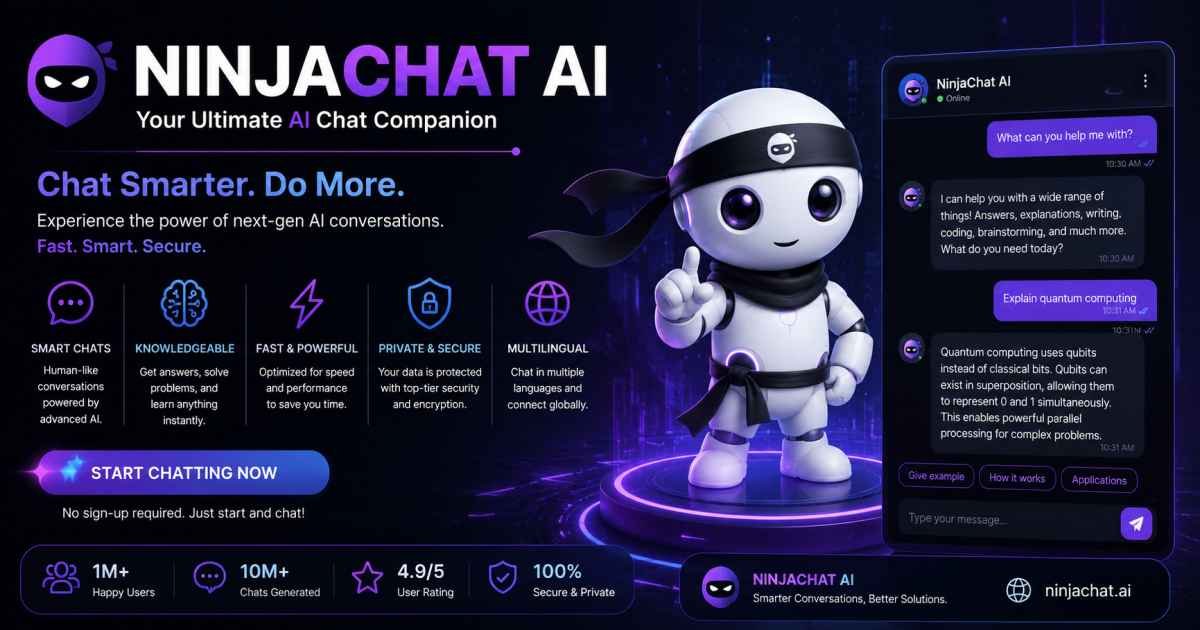
Artificial intelligence has transformed how individuals and businesses create content, conduct research, write code, generate images, and automate daily tasks. As AI tools continue to evolve, many users are looking for platforms that combine multiple AI capabilities into a single workspace. NinjaChat AI has emerged as one of the most talked-about AI productivity platforms in 2026, offering an integrated environment where users can access advanced AI models and creative tools without constantly switching between different applications.
Whether you’re a student, marketer, entrepreneur, software developer, content creator, freelancer, or business owner, NinjaChat AI aims to simplify workflows by bringing writing, coding, research, brainstorming, and image generation together in one place.
This comprehensive guide explains what NinjaChat AI is, how it works, its features, benefits, pricing considerations, practical use cases, and why it is gaining popularity in 2026.
What Is NinjaChat AI?
NinjaChat AI is an AI-powered productivity platform designed to help users complete a wide variety of digital tasks using advanced artificial intelligence. Rather than focusing on a single function, it provides a centralized workspace where users can generate content, summarize information, write code, brainstorm ideas, and perform research more efficiently.
Depending on the available integrations and subscription plan, NinjaChat AI may provide access to multiple leading AI models, allowing users to choose the most suitable model for different tasks.
Common uses include:
- Content writing
- Blog article generation
- Marketing copy
- Programming assistance
- Code debugging
- Research summaries
- Business planning
- Email drafting
- Image generation
- Idea brainstorming
By consolidating these capabilities into one interface, NinjaChat AI helps reduce the need for multiple separate AI tools.
Why Is NinjaChat AI Popular in 2026?
The rapid adoption of AI-powered workflows has significantly increased interest in platforms like NinjaChat AI.
Several factors contribute to its popularity.
All-in-One Convenience
Instead of subscribing to several different AI services, users can manage multiple tasks within one platform.
Improved Productivity
AI accelerates repetitive tasks, enabling users to focus on strategy, creativity, and decision-making.
Support for Multiple Professions
The platform serves a wide audience, including writers, developers, educators, marketers, researchers, and entrepreneurs.
Continuous AI Innovation
Frequent improvements in language models and creative AI systems expand the platform’s capabilities over time.
Growing Business Adoption
Companies increasingly integrate AI into everyday operations to improve efficiency, customer service, and content production.
Key Features of NinjaChat AI
One of the biggest advantages of NinjaChat AI is the variety of tools available within a single workspace.
AI Writing Assistant
Users can generate:
- Blog posts
- Product descriptions
- Email campaigns
- Social media content
- SEO articles
- Advertising copy
- Business proposals
- Creative writing
Coding Support
Developers can use NinjaChat AI to:
- Write code
- Debug programs
- Explain algorithms
- Generate scripts
- Learn programming concepts
- Optimize existing code
Research and Summarization
The platform helps users quickly organize information by summarizing lengthy documents and highlighting key points.
Image Generation
Many AI productivity platforms now include tools that transform text prompts into original digital artwork and marketing visuals.
Idea Brainstorming
Users can develop business ideas, marketing campaigns, lesson plans, product concepts, and creative projects more efficiently with AI-assisted brainstorming.
How NinjaChat AI Can Improve Productivity
The platform supports numerous everyday workflows across different industries.
For Students
Students can use NinjaChat AI to:
- Summarize study materials
- Explain difficult concepts
- Organize research
- Draft assignments
- Improve writing
For Content Creators
Creators benefit from:
- Faster content production
- SEO optimization
- Script writing
- Video planning
- Social media scheduling
For Businesses
Organizations can automate:
- Customer communication
- Internal documentation
- Marketing campaigns
- Business reports
- Workflow planning
For Software Developers
Developers can increase efficiency through AI-assisted coding, debugging, documentation, and project planning.
Benefits of Using NinjaChat AI
As AI becomes more integrated into professional workflows, platforms like NinjaChat AI provide several significant advantages.
Key benefits include:
- Higher productivity
- Reduced manual work
- Centralized AI workspace
- Improved creativity
- Faster content creation
- Better research efficiency
- Support for multiple AI-powered tasks
- Time savings
- Scalable workflows
- Enhanced collaboration
These benefits make NinjaChat AI attractive for both individuals and teams.
Pricing, Limitations, and Best Practices
Like many AI platforms, NinjaChat AI may offer a combination of free and premium subscription plans, with higher-tier plans typically providing expanded usage limits, additional AI models, faster responses, or advanced collaboration features.
Users should also understand certain limitations.
Review AI Output Carefully
AI-generated responses should always be checked for accuracy, especially when working with technical, financial, legal, or medical information.
Protect Sensitive Data
Avoid entering confidential personal or business information unless you understand the platform’s privacy and security policies.
Stay Updated
AI platforms evolve rapidly, and new features or integrations may become available over time.
Use AI as an Assistant
The most effective approach combines AI-generated suggestions with human expertise, creativity, and critical thinking.
Frequently Asked Questions About NinjaChat AI
What is NinjaChat AI?
NinjaChat AI is an AI productivity platform that combines writing assistance, coding support, research tools, brainstorming, and other AI-powered features within a unified interface.
Who can use NinjaChat AI?
The platform is suitable for students, freelancers, developers, marketers, educators, researchers, entrepreneurs, and business teams.
Does NinjaChat AI support coding?
Yes. It is commonly used for code generation, debugging, explanations, and programming assistance.
Is NinjaChat AI free?
Many AI productivity platforms provide free plans alongside premium subscriptions, with advanced capabilities available in paid tiers. Features and pricing may change over time.
Can businesses use NinjaChat AI?
Yes. Organizations often use AI productivity platforms to improve content creation, automate workflows, enhance customer communication, and support internal operations.
Conclusion
NinjaChat AI represents the growing trend toward all-in-one AI productivity platforms in 2026, bringing together content creation, coding assistance, research, brainstorming, and creative tools within a single environment. By reducing the need to switch between multiple applications, it helps users save time, streamline workflows, and improve overall efficiency.
Whether you’re writing articles, developing software, creating marketing campaigns, conducting research, or managing business operations, NinjaChat AI provides a flexible AI-powered workspace that supports a wide range of professional and personal tasks. As artificial intelligence continues to evolve, platforms like NinjaChat AI are expected to play an increasingly important role in helping individuals and organizations work smarter, innovate faster, and unlock new creative possibilities.
The internet constantly introduces new words, concepts, and brand names that spark curiosity. One such term gaining attention is Woeken. Whether you’ve encountered it in online discussions, branding, usernames, creative projects, or search results, you may be wondering what it actually means and why people are searching for it.
In 2026, Woeken remains an emerging keyword without a universally accepted definition. Instead, it represents a flexible digital term that can be adapted across industries, communities, and creative projects. As unique names become increasingly valuable for branding and search engine visibility, Woeken stands out because of its originality, memorable spelling, and broad usability.
This guide explores everything currently known about Woeken, its potential meanings, applications, branding opportunities, SEO value, and why it could become more recognizable in the future.
What Is Woeken?
Woeken is best described as a distinctive digital keyword that does not yet have a fixed dictionary definition. Unlike common English words, it appears primarily as a unique identifier rather than a traditional vocabulary term.
Because of this flexibility, Woeken can represent:
- A personal brand
- A startup or technology company
- A creative project
- A gaming identity
- A software platform
- A design studio
- An online community
- A digital product
- A domain name
- A modern business brand
Its uniqueness is one of its greatest strengths. Since there are relatively few established meanings associated with the word, creators have the freedom to build their own identity around it.
Why Is Woeken Becoming Popular?
Modern branding increasingly favors invented words instead of traditional descriptive names. Companies and creators often choose unique names because they are easier to trademark, easier to remember, and more likely to rank in search engines.
Several factors contribute to growing interest in Woeken:
Unique Branding
Businesses prefer names that stand apart from competitors. Woeken sounds modern while remaining easy to pronounce.
Better SEO Opportunities
Since the keyword has limited competition compared to generic phrases, websites optimized around Woeken have a better opportunity to establish authority as more content is created.
Memorable Identity
Short, distinctive words are easier for audiences to remember, making them suitable for digital businesses.
Flexible Usage
Woeken isn’t restricted to a single industry. It can be adapted to technology, education, design, entertainment, commerce, and many other sectors.
International Appeal
Its spelling is relatively simple, making it accessible to audiences across different countries and languages.
Possible Meanings of Woeken in 2026
Since no universally accepted definition exists, Woeken can be interpreted in several practical ways depending on context.
A Technology Platform
Woeken could serve as the name of an innovative software platform, AI tool, cloud service, or digital application.
A Creative Brand
Graphic designers, photographers, filmmakers, musicians, and artists often seek original names that distinguish their work.
An E-commerce Business
Many successful online stores use invented names that become associated with quality products rather than descriptive keywords.
A Gaming Identity
Gamers frequently create unique usernames that eventually evolve into recognizable online brands.
A Digital Community
Woeken could represent a forum, educational platform, collaborative workspace, or knowledge-sharing network.
A Startup
Technology startups often launch with completely original names before building global recognition.
SEO Advantages of Using Woeken
One reason marketers appreciate original keywords is their long-term search engine optimization (SEO) potential.
Some benefits include:
Lower Keyword Competition
Generic keywords often have millions of competing pages. Woeken currently has much less competition, allowing newer websites to establish topical authority more quickly.
Strong Brand Recognition
Repeated exposure helps users associate Woeken directly with your website rather than with multiple unrelated businesses.
Easier Content Strategy
A website built around Woeken can expand into numerous related topics while maintaining consistent branding.
Improved Domain Opportunities
Unique names often provide better chances of securing memorable domain names and social media handles.
Better Click-Through Rates
Distinctive titles naturally attract curiosity, encouraging users to click and learn more.
Industries Where Woeken Could Be Used
One of Woeken’s biggest advantages is its versatility. It can fit naturally into many industries.
Technology
- AI platforms
- SaaS products
- Mobile apps
- Cloud computing
- Automation tools
Digital Marketing
- SEO agencies
- Content creation
- Branding services
- Analytics platforms
Creative Industries
- Photography
- Graphic design
- Video production
- Music publishing
- Digital art
Education
- Online learning platforms
- Study resources
- Educational communities
- Knowledge-sharing websites
Business
- Consulting firms
- Startup incubators
- Innovation hubs
- Corporate training
E-commerce
- Lifestyle brands
- Fashion stores
- Home products
- Electronics retailers
This flexibility gives Woeken long-term branding potential regardless of industry trends.
How to Build a Brand Around Woeken
If you’re considering using Woeken as a business or personal brand, focus on creating a strong identity that reflects your goals.
Define Your Purpose
Decide what Woeken will represent. Is it a technology company, creative portfolio, educational platform, or online store?
Create a Professional Visual Identity
Develop:
- A memorable logo
- A consistent color palette
- Modern typography
- Professional graphics
- Brand guidelines
Produce High-Quality Content
Publish informative articles, tutorials, videos, case studies, and resources related to your niche. Valuable content helps establish trust and authority.
Optimize for SEO
Use Woeken naturally in:
- Page titles
- Meta descriptions
- Headings
- Image alt text
- Internal links
- URL structures
Combining branded content with broader industry keywords can help attract both branded and non-branded search traffic.
Build Community Engagement
Grow recognition through newsletters, social media, discussion forums, and customer interactions. A loyal audience strengthens brand awareness over time.
The Future of Woeken
As the internet continues expanding, original digital names will remain highly valuable. Whether Woeken becomes a successful company, a popular platform, or a recognized online community depends on how it is adopted and developed.
Its greatest strengths include:
- Originality
- Brand flexibility
- SEO potential
- Global usability
- Memorable pronunciation
- Wide industry applicability
If supported by quality products, useful content, and consistent branding, Woeken could evolve from an emerging keyword into a recognizable digital identity.
Conclusion
Woeken represents the growing trend of unique digital-first branding in 2026. While it does not currently have a single established dictionary definition, its originality makes it highly adaptable for businesses, startups, creators, developers, educators, and entrepreneurs.
Because it carries minimal historical baggage, Woeken offers a blank canvas for innovation. It can serve as the foundation for a technology platform, creative studio, educational resource, e-commerce brand, or online community. From an SEO perspective, its uniqueness provides opportunities to build authority around a memorable keyword while facing less competition than generic terms.
As more creators seek distinctive names that stand out in search engines and digital marketplaces, Woeken has the potential to become far more recognizable in the years ahead. For anyone searching for a modern, flexible, and future-ready identity, Woeken is a name worth watching in 2026.

Tatsuya Shiba: Biography, Powers, Personality, and Story Explained

Met Live in HD: Complete Guide to the Metropolitan Opera’s Live Broadcasts

Boy in ASL: How to Sign “Boy” in American Sign Language

Droven.io Review 2026: The Honest Truth About This AI Knowledge Platform

Keiko Fujimoto: The Life and Legacy of Sunny Balwani’s Ex-Wife

The Enigmatic Life of Solica Casuto: From Greek Actress to Andy Griffith’s Second Wife and Her Choice of Privacy
 Tech3 months ago
Droven.io Review 2026: The Honest Truth About This AI Knowledge Platform
- Fashion3 months ago
Keiko Fujimoto: The Life and Legacy of Sunny Balwani’s Ex-Wife
- Fashion3 months ago
The Enigmatic Life of Solica Casuto: From Greek Actress to Andy Griffith’s Second Wife and Her Choice of Privacy
- Fashion3 months ago
Mark Fluent: Your Comprehensive Guide to Achieving Peak Performance and Unlocking Your True Potential
- Sports3 months ago
Amy Dettbarn: The Untold Story of the Woman Behind UConn Star Paige Bueckers
- Tech3 months ago
Antonimar Mello: The Quiet Strength Behind a Pop Icon
- Fashion3 months ago
Carlos Scola Pliego: The Spanish Filmmaker Who Captured Sade’s Heart
- Fashion2 months ago
Monika Leveski : Biography, Design Philosophy, Art Career, and Modern Elegance Explained